
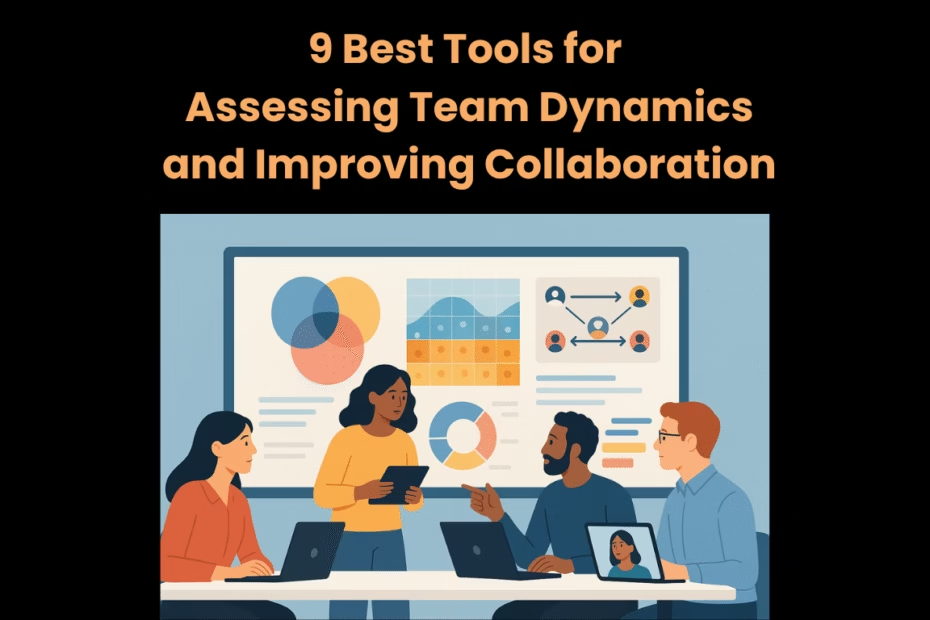
Team assessment tools have shifted from novelty to necessity. In 2023, managers poured an estimated $2 billion into a market stocked with more than 2,000 personality-testing instruments to keep hybrid teams aligned. Yet shaky communication still siphons about 7.5 hours from every knowledge worker each week—roughly $12,500 in annual lost productivity per employee, according to Grammarly Business. We reviewed nine proven platforms—ranging from free strengths surveys to enterprise-grade psychometrics—to reveal who they help, what they cost, and how fast they can sharpen day-to-day collaboration.
Our selection and evaluation process
Inclusion screen: who made the cut
We applied for four quick tests. Miss one, and the tool was out.
- Team-level focus. Must map how colleagues interact, not just tag individual personalities.
- Published methodology. Either a peer-reviewed study or a public technical manual; marketing copy alone didn’t count.
- Proven adoption. Minimum 100 paying organizations, or a 4-plus-star rating on a major review site, to avoid beta-test risk.
- Rapid, shareable output. A team-level dashboard delivered within an hour, no consultant scheduling required.
Scoring rubric: how we ranked the finalists
Survivors earned up to 100 points across six factors:
| Factor | Weight |
| Actionable advice | 25 |
| Scientific validity | 20 |
| Ease of rollout | 15 |
| Reporting depth | 15 |
| Value for money | 15 |
| Adoption support | 10 |
These weights mirror common HR evaluation models and focus on tips that land in Monday’s stand-up, not academic perfection.
Together, the screen and the rubric make the nine tools that follow both credible and practical for working managers.
Quick-glance comparison table
Still digging through vendor pages? The grid below lists the essentials so you can spot deal-breakers in seconds.
| Tool | Core lens | Completion time | Ideal team size | Typical cost* | Facilitator required |
| TeamDynamics | Team habits snapshot | 10–15 min | 5–20 | $39 pp | No |
| VIA Character Strengths | Values & morale | 10–15 min | 2–unlimited | Free–$49 pp | No |
| Everything DiSC | Communication style | 15–20 min | 5–500 | $64–$120 pp | Optional |
| Insights Discovery | Four-color interaction | about 20 min | 5–100 | $180–$350 pp | Yes |
| MBTIonline Teams | Personality preferences | 30–45 min | 5–200 | $99 pp | No |
| CliftonStrengths | Strengths grid | 30–35 min | 5–500 | $25–$60 pp | No |
| Belbin Team Roles | Role balance | 15 min + peer input | 4–20 | about $75 pp | Usually |
| Predictive Index | Behavioral drives | 6 min | 20+ | Annual license (low-five figures) | Certified PI Champion |
| Hogan Team Report | Leadership traits & derailers | 3 × 15 min | 5–15 leaders | $350+ pp | Yes |
*Typical retail pricing from vendor sites and 2025 consultant quotes. Group discounts may apply. †Belbin includes optional peer ratings that add 5–10 min per participant.
Choose the options that fit your time and budget, then jump to the deep-dive sections that follow.
TeamDynamics: the team personality snapshot
TeamDynamics is a fast, research-backed way for teams to understand how they work together – not by labeling individual personalities, but by examining real team behaviors. After each teammate completes a short assessment, the platform identifies your group’s unique TeamDynamics type, one of 16 team “personalities” grounded in how modern teams communicate, process information, make decisions, and get work done. Every person also receives an individual CoDynamics profile that shows how their preferred working style aligns with or differs from the team’s overall patterns, making invisible team dynamics clear and actionable.
The assessment takes only a few minutes per person, and once everyone has finished, the platform instantly delivers an interactive, shareable results report. The report highlights your team’s strengths, friction points, communication tendencies, decision-making habits, and execution style. Managers get tactical guidance tailored to their team type, and the entire team gains a shared language to use in retros, offsites, and everyday collaboration. Because TeamDynamics focuses on team behaviors rather than individual personality traits, it is far more relevant for workplace effectiveness than tools like MBTI, StrengthsFinder, Enneagram, Big Five, or DiSC, which provide little insight into how teams function as a whole.
Using TeamDynamics is simple: invite your team, take the quick assessment, and explore results within minutes – no integrations, HRIS setup, IT involvement, or complex onboarding required. Everything is self-serve and lives online, making it easy for distributed, hybrid, and fast-moving teams to use. Teams typically rely on the insights to spark conversation, improve workflows, and adapt leadership or collaboration approaches so the team can operate more naturally and effectively.
Pricing includes a free trial that offers rapid results based on sample questions, a $39 one-time fee per user for TeamDynamics Pro (for teams of 2–20), a $29 one-time fee for individuals using TeamDynamics Solo, and custom pricing for Enterprise plans and for coaches or consultants who want to bring the framework into their practice.
VIA Character Strengths: values that lift team morale
If you want a quick pulse on what motivates your colleagues, VIA is a solid choice. The free, science-based survey takes about 15 minutes and ranks 24 character strengths from Curiosity to Kindness.
Teams often focus on their shared top five. Seeing high Perseverance but low Prudence, for instance, explains why deadlines slip even while energy stays high. The virtue-based language keeps the conversation affirmative rather than diagnostic: “Creativity tops your list. How can we weave that into the next sprint?”
A basic profile is free. Deeper insights arrive in the Total 24 Report ($49 per person), which adds coaching tips and offers discounts for larger groups. The platform will not map communication quirks or workflow gaps, so pair it with a process-oriented assessment if you need those details.
VIA shines as a culture booster, giving teams a low-stakes way to show appreciation and link recognition to what truly drives each teammate.
EverythingDiSC: color-coded conversations that stick
When daily stand-ups feel like people are speaking four dialects, EverythingDiSC offers a quick translation. The research-validated questionnaire takes about 15–20 minutes to complete and plots each person across four styles—Dominance, influence, Steadiness, and Conscientiousness—often linked to red, yellow, green, and blue for easy recall.
That simplicity lasts. Months after a workshop, someone might say, “High D here, let’s keep it brief,” and tension eases. Results land in the Catalyst platform, where any two teammates can click Compare and get tailored tips on pitching ideas or solving friction.
Pricing runs $64–$90 per person depending on volume, and you can self-debrief or bring in a certified facilitator. Either way, most teams see results quickly in fewer email threads, clearer requests, and crisper meetings.
Remember, DiSC addresses communication style only; it will not predict job fit or reveal deep values. For groups who stumble over tone more than talent, this single lens is often the quickest route to smoother conversations.
Insights Discovery: four colors, one shared language
Insights boils Jungian preferences down to four “color energies”: Fiery Red, Sunshine Yellow, Earth Green, and Cool Blue. The online evaluator takes about 20 minutes and produces a personal-plus-team profile that 98 percent of participants rate as accurate.
The payoff is visceral. During a workshop, people stand on a floor mat that maps their dominant color; the room’s palette instantly shows whether the team leans analytical Cool Blue or high-energy Sunshine Yellow. That shared visual sticks. Months later someone might say, “Dial up some Yellow,” and everyone knows what to do.
Cost: U.S. distributors quote $150–$325 per participant for a profile plus a half-day workshop. A certified facilitator is required, and accreditation runs close to $5,000 for in-house trainers, so plan for both people time and practitioner fees.
Why invest? Nearly 48 percent of Fortune 500 companies use Insights Discovery, and an ROI study found every dollar spent returned $20.63 in business value. Its reliability is good, not stellar, so treat the profiles as conversation starters rather than hard science.
Choose Insights when you want a memorable, high-energy reset and have the budget for a facilitated experience that embeds a color language your team will reference long after the workshop ends.
MBTIonline Teams: the familiar four-letter handshake
Few assessments carry brand recognition like the Myers-Briggs Type Indicator. MBTIonline updates the classic so distributed teams can go self-serve.
Participants answer 93 forced-choice items in about 25–30 minutes. The platform then plots every ENFP, ISTJ, and INTP on a shared dashboard and adds short modules on conflict, feedback, and decision-making.
Pricing is a flat $99.95 per person for teams of 3–30 members. That fee secures lifetime access to the portal plus four self-paced learning courses. No certified facilitator is required, although volume discounts start above 50 seats.
Why consider it? The publisher reports that 88 percent of Fortune 500 companies use the MBTI tool somewhere in their people-development mix. Familiar four-letter codes make even skeptics willing to discuss preferences, often the hardest step in team growth.
Limitations remain: test-retest reliability is lower than trait-based tools, and the four dichotomies gloss over nuance. Treat MBTIonline as a friendly gateway into self-awareness. If your team later wants granular data or derailers, add a deeper instrument.
Use MBTIonline when you need a low-resistance icebreaker and a shared language most professionals already speak.
CliftonStrengths: spotlight what your team does best
Gallup’s CliftonStrengths shifts the conversation from fixing gaps to amplifying talent. Team members respond to 177 paired statements in about 30–40 minutes, and the algorithm ranks their 34 talent themes. Most teams begin with the Top 5 report ($24.99 per person) and later upgrade to the full 34-theme version ($59.99) for deeper insight.
Seeing everyone’s themes on one grid makes strengths painfully clear: plenty of Futuristic ideators, not enough Discipline to meet deadlines. Managers can then realign work to talent: let the Achiever own the launch checklist, ask Woo to secure stakeholder buy-in, and invite Relator to mentor the new hire.
Gallup links strengths-based development to 19 percent higher sales and 72 percent lower attrition in longitudinal studies, which helps the modest fee pay for itself. Remember, though, the tool is individual first. Plan time to discuss theme gaps and overlaps, or the colorful grid will fade into the background.
Choose CliftonStrengths when you want a lively, research-backed way to reassign tasks around natural talent without wading through heavy psychology jargon.
Belbin Team Roles: mind the missing Finisher
Belbin focuses on behavioral roles, not personality traits. After a 20-minute Self-Perception Inventory plus optional peer feedback, each participant receives a mix of nine roles: Plant for ideas, Coordinator for delegation, Completer-Finisher for detail, and so on.
A team report flags overloads and gaps. If your chart is heavy on creative Plants but light on Completer-Finishers, missed deadlines start to make sense, and hiring plans sharpen.
Pricing is clear. A Belbin Individual report costs about £39 plus VAT (around $50), and team packages run $70–$110 per person, including a half-day facilitated session. Observer ratings come free once you buy a report, so you capture both self-view and colleague perception without extra fees.
Belbin fits project teams of 4–20 people where workload balance matters more than deep psychometrics. Use it when the task list feels lopsided and no one can explain why; the visual role map makes delegation and accountability far less subjective.
The Predictive Index: one platform from hiring to high-performing teams
The Predictive Index (PI) does more than diagnose; it also prescribes. The Behavioral Assessment takes about six minutes—just two word-choice pages—and has been completed by more than 25 million people worldwide. The algorithm maps each person on four drives—Dominance, Extraversion, Patience, Formality—and rolls the pattern into a plain-language profile such as Maverick or Guardian.
The payoff shows up in Team Discovery. Drop your squad’s profiles onto the canvas and test them against a goal, for example “rapid innovation.” The dashboard flags over- or under-represented drives, then lets you add a hypothetical new hire to preview the chemistry shift.
PI is sold as an annual SaaS license. Public price pages list bundles starting at $9,950 per year for unlimited assessments and dashboards. Many mid-market firms add a Team Development module (about $4,950) and train an internal PI Champion in a two-day course that runs around $2,500.
Choose PI when you need a single language from hiring through succession planning and have the budget for an enterprise-grade, data-driven talent strategy. Smaller teams seeking only a morale boost can likely find lighter tools at a lower cost.
Hogan Team Report: the executive-grade X-ray
When the stakes include M&A integration or CEO succession, surface-level insights will not suffice. Hogan’s Team Report aggregates three validated inventories:
- HPI (day-to-day style)
- HDS (derailers under stress)
- MVPI (core motives and values)
Each inventory takes 15–20 minutes, so a six-person leadership team can finish in about one hour. A certified coach then walks the group through a 30-page report that pinpoints shared derailers (for example, Skeptical, Cautious) and culture gaps between values such as Tradition and Recognition.
The science is robust. Hogan processes about one million assessments per year across more than 50 countries and is used by approximately 75 percent of the Fortune 500. Pricing is premium: consultants quote $350–$500 per leader plus a half-day debrief that averages $3,000.
Choose Hogan when you need a clinical-grade mirror and leadership is ready for blunt, research-backed feedback rather than a feel-good off-site.
How to choose the right tool for your team
Use this three-part screen to narrow more than two thousand options to a short list in minutes.
- Tie the tool to the problem. Start with the outcome, not the logo. Missed deadlines? A role balancer such as Belbin or CliftonStrengths clarifies who owns follow-through. Slack threads turning testy? A communication lens like Everything DiSC or Insights Discovery provides an instant shared vocabulary. Need to surface executive derailers? Deep dives like Hogan or PI reach that level.
- Reality-check time and money.
- Team bandwidth: a 10-minute TeamDynamics pulse fits Tuesday’s stand-up, while an Insights workshop needs a half-day block.
- Budget: under $500 covers VIA or a CliftonStrengths Top 5 for ten people, while a full Hogan engagement can exceed $5,000. Map these facts before you chase shiny feature lists.
- Match the tool to team culture. Data-oriented engineers often prefer PI dashboards. Creative marketers gravitate toward color metaphors. Some leaders appreciate Hogan’s blunt candor, whereas others like MBTI’s gentle tone. Choose a format the group will discuss openly; Google’s Project Aristotle found that psychological safety (see our guide on the power of appreciation in the workplace) is the top predictor of team effectiveness. If people will not talk about the results, the insight stays trapped in a PDF.
Run each contender through these three filters—goal, logistics, and culture—and the right choice usually reveals itself in one meeting.
Roll-out tips and common pitfalls
- Set the stage. Explain why you are running the assessment, how results will be used, and what is off-limits (for example, performance reviews). This transparency fuels psychological safety, which Google’s Project Aristotle names as the top predictor of team effectiveness.
- Time-box the cycle.
- Send the link and ask everyone to finish within 24 hours.
- Hold the debrief within 7 days, while curiosity is high.
Momentum fades quickly once results sit in inboxes.
- Run a balanced debrief. Start with one insight that rang true and one that felt off. This mix maintains healthy skepticism and avoids the label trap—treating profiles as destiny.
- Turn insights into agreements. Translate findings into clear commitments:
“Half of us score low on Conscientiousness, so we will rotate a weekly documentation owner until the habit sticks.” Record agreements where work lives, such as Jira, Notion, or your team charter.
- Check back in 30 days. Ask three questions:
- Have we used the new language?
- What has improved?
- What still frustrates us? Tweak norms or choose a deeper tool based on the answers.
- Avoid two classic traps.
- Launching multiple assessments at once, which causes vocabularies to collide and people to tune out.
- Handing the debrief to HR while managers stay silent; if leaders do not model the conversation, no one will.
Read More: Top 7 AI Humanizer Tools in 2025 (And How They Improve Content Quality)
Conclusion
The right team-assessment tool doesn’t just generate a report—it sparks the conversations and habits that make collaboration actually work. By choosing a solution that matches your team’s goals, constraints, and culture, you’ll turn insights into practical agreements that improve communication, clarify roles, and boost day-to-day effectiveness. Keep the rollout simple, focus on one shared language, and revisit the results regularly. With the right approach, your assessment becomes a lasting catalyst for a more aligned, higher-performing team.