
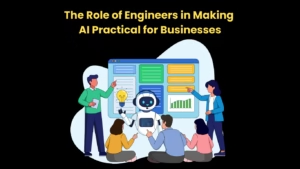
Artificial intelligence sounds exciting in boardrooms and headlines. It promises automation, better insights, and faster decisions. But inside most companies, the real question is simple: how do we make AI actually work for us? This is where engineers matter most. They turn big ideas into real systems that help teams every day. Without engineers, AI remains a demo or a trial project. With them, it becomes a dependable tool that supports growth.
AI models alone are not solutions. They are engines that need structure, clean data, and thoughtful design. Engineers connect AI to business tools such as CRMs, accounting systems, ad platforms, and internal dashboards. They build the data pipelines that keep information clean and organized. They also make sure systems run quickly and safely. When engineers do this work well, AI becomes something employees trust instead of something they fear.
Engineers also reduce risk. AI can generate errors if it is not guided carefully. Engineers create rules, testing systems, and monitoring tools that keep results accurate. They spot issues early and fix them before customers notice. This behind-the-scenes work is what makes AI practical instead of unpredictable. Businesses that treat engineering as strategy, not just support, are the ones that see real value from AI.
From Concept to Infrastructure
Turning AI into a useful business tool starts with strong infrastructure. Most companies already rely on many digital systems. Engineers design how AI fits into that environment without breaking it. They ensure data flows correctly from one tool to another. They also build systems that protect customer information and meet compliance standards.
Clean data is the foundation of good AI. If data is messy, results will be unreliable. Engineers build pipelines that filter, structure, and validate data before it reaches AI models. This improves accuracy and confidence. It also saves time for teams who depend on those outputs.
Performance is just as important. AI must respond quickly and consistently. Engineers optimize speed and stability. They create fallback systems so workflows continue even if one service fails. These small decisions make a huge difference in day-to-day operations.
Arnab Dey, Founder, Hela Lanka Ads, shares:
“When we built Hela Lanka Ads, I focused first on clean structure and fast performance. AI only adds value when the foundation is solid. Our engineering decisions around SEO architecture and data flow help listings rank and convert. Practical AI depends on disciplined system design.”
Arnab’s experience highlights an important point. AI cannot fix weak foundations. Engineers ensure the core system is strong before adding intelligent layers. This approach prevents wasted effort and builds long-term stability.
Making Complex Systems Feel Simple
AI can be complex behind the scenes, but users do not want complexity. They want clarity. Engineers play a key role in making advanced systems feel easy to use. They design dashboards, automation flows, and interfaces that guide users clearly.
This balance between power and simplicity drives adoption. If a system feels confusing, teams avoid it. If it feels intuitive, it becomes part of daily workflow. Engineers often work closely with product teams to refine user experience while maintaining technical strength.
Kevin Lourd, Founder and CEO, PressBeat, explains:
“At PressBeat, our AI scans millions of journalist profiles, but users see a clean and simple experience. Engineers make that possible by hiding complexity behind strong systems. I believe great products feel easy because the hard work happens underneath. That simplicity builds trust.”
Kevin’s approach shows how engineering supports usability. When AI outputs are structured clearly and presented thoughtfully, businesses can act on insights quickly. Simplicity increases efficiency and reduces training time.
Building Reliability and Long-Term Trust
For AI to be practical, it must be reliable. If results feel random or inconsistent, teams lose confidence. Engineers constantly test and monitor systems to maintain quality. They create alerts for unusual behavior and refine models when performance shifts.
Reliability also means security. AI systems often process sensitive information. Engineers build encryption, access controls, and monitoring tools that protect data. This reduces legal and financial risk. It also strengthens customer trust.
AI systems require ongoing care. They need updates, retraining, and optimization. Engineers manage this lifecycle. They ensure systems evolve alongside business needs rather than becoming outdated tools.
Scalability is another factor. A system that works for 100 users must also perform for 100,000. Engineers design architecture that supports growth. They anticipate traffic spikes and build flexible systems that handle expansion smoothly.
Aligning AI with Real Business Goals
AI becomes practical when it connects directly to measurable outcomes. Engineers work with leadership to define clear use cases. Instead of chasing trends, they focus on problems that matter. This focus reduces wasted investment.
In industries like real estate, AI can analyze property data, predict trends, and guide investment decisions. But raw data alone does not create value. Engineers design systems that turn information into clear recommendations.
Zuri Obozuwa, Founder and CEO, Bluestairs, says:
“At Bluestairs, our AI supports real investment decisions. Engineers connect market data, financial models, and predictive logic into one clear system. I have learned that without strong engineering, AI insights feel abstract. With it, they become actionable.”
Zuri’s insight shows how engineering bridges theory and action. Businesses need clarity, not just analytics. Engineers structure AI so decision-makers can act confidently.
Continuous Improvement and Measurable Results
AI is not a one-time installation. It requires continuous refinement. Engineers design testing frameworks that measure impact and guide improvements. They compare outcomes, adjust models, and optimize workflows.
This process builds momentum. As systems improve, confidence grows. Teams rely more on AI because it consistently delivers value. Engineers also document systems clearly, which supports onboarding and reduces confusion.
Companies that overlook engineering often struggle with stalled AI projects. Tools remain underused. Teams revert to manual work. In contrast, businesses that invest in strong engineering practices see steady progress and measurable returns.
Engineers also educate teams. They explain system limits and strengths. This transparency prevents unrealistic expectations. When employees understand how AI works, they use it more effectively and responsibly.
Read More: Why Your “Power Suit” Fails: Mastering First Impressions with AI Color Analysis
Conclusion: Engineers Turn AI into Practical Business Tools
AI has enormous potential, but potential alone does not drive results. Engineers transform AI into systems that work every day. They build infrastructure, protect data, simplify user experience, and ensure reliability.
The key lesson is clear. Practical AI depends on thoughtful engineering. Businesses that invest in strong technical foundations unlock real value and reduce risk. Engineers are not just technical contributors. They are the bridge between innovation and impact.