
If you’re an entrepreneur or marketer running ads, you know the feeling. The leads are coming in from your campaigns, but your team—or perhaps just you—is drowning in direct messages. You understand that “speed-to-lead” is important, but replying instantly 24/7 is impossible. Every missed chat is a potential lost sale.
This is the exact problem that WhatsApp marketing automation promises to solve. Teams evaluating platforms can compare WhatsApp automation tools to find an option that fits their sales and support workflows. It offers a way to scale your conversations and your sales process without necessarily scaling your payroll.
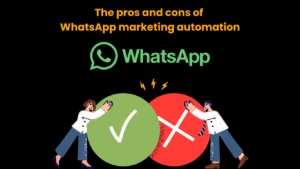
But automation is a double-edged sword. When implemented correctly, it builds a 24/7 sales machine that nurtures leads and delights customers. When done poorly, it risks alienating your hard-won audience with robotic, impersonal messages.
This isn’t a simple “pro vs. con” list. This is a strategic guide for entrepreneurs. It’s about how to seize the undeniable advantages of automation while navigating the very real—and very solvable—challenges.
The pros: Why automation is a non-negotiable revenue driver
For a growing business, the benefits of automation extend far beyond just “saving time.” When you save time on manual replies, you redirect that energy into systems that generate revenue, create scale, and provide better data for future decisions.
From “inbox zero” to “sales engine”: Scaling lead conversion 24/7
The primary advantage of a well-built automation system is its ability to turn your inbox from a “to-do list” into a “sales engine.”
Many businesses lose sales in the time-gap between a customer’s inquiry and a human’s reply. Research in lead management often highlights that leads are significantly more likely to convert if they receive a response within the first hour, or even the first five minutes. Automation makes this response instant, capturing the lead’s interest at its peak.
This system can be designed to do more than just say “hello.” It can qualify leads, nurture them through a sequence, or even send a broadcast message in WhatsApp to a highly segmented list of customers, such as notifying them of a flash sale or a product restock.
Imagine a lead clicking your Instagram Ad at 2 AM. Without automation, they are met with silence. With it, they are instantly engaged, asked a few qualifying questions, and can even be sent a relevant lead magnet. When your sales team logs on in the morning, they have a qualified, warm lead waiting for them, not a cold inquiry from eight hours ago. Treating WhatsApp as one channel inside a wider stack is what separates ad hoc automation from mature conversational AI platforms, where messaging, CRM, email, and web data are tied together so every reply feels informed.
This same logic applies powerfully to e-commerce. You can trigger automated sequences to recover abandoned carts, a task that is nearly impossible to do manually at scale. This single feature is often described as “found money,” as it re-engages customers who were already on the verge of buying.
Unlocking hyper-personalization at scale (that humans can’t match)
There is a common misconception that automation is inherently impersonal. The opposite is often true. A stressed, busy human employee juggling ten conversations at once is far more likely to be impersonal than a well-programmed automation.
Good automation is more personal because it can leverage data with perfect memory and instant recall. By integrating your WhatsApp automation platform, such as GetItSMS, Getgabs, and Messagedly, with your CRM or e-commerce store, you can segment your audience with incredible precision.
This same principle of using data to trigger messages is why Instagram DM automation has also become so effective for brands. It allows you to create rules based on customer behavior, keywords, or tags.
This prevents the common human error of sending a “10% Off Your First Order” coupon to a loyal customer who has spent thousands with your brand. That kind of mistake damages brand equity, and it’s a mistake that data-driven automation simply doesn’t make.
The “cons”: Navigating the implementation hurdles (that stop your competitors)
The challenges of automation are not reasons to avoid it. They are operational hurdles to manage. For an entrepreneur, these “cons” are actually strategic barriers to entry. They are the friction that stops your lazy competitors from doing it right.
The “robot” risk: Protecting your brand from impersonal automation
The biggest fear for any business owner is this: “I don’t want to sound like a robot.” This is a valid concern. We have all experienced frustrating, poorly designed automation that traps us in a loop and makes us want to throw our phones.
But the tool is not the problem; the strategy is. Your automation will only sound robotic if your script is robotic. The solution is to design your automation with a clear, non-negotiable rule: the “human hand-off.”
The goal of your automation should not be to solve every complex customer issue. Its primary job is to qualify, segment, and handle the 80% of repetitive questions. For everything else, it should seamlessly transfer the customer to a human sales rep for closing or support.
You also solve this by investing time in your brand voice. Write your scripts like a person, not a machine. Use emojis where appropriate, use the customer’s {first_name} variable, and avoid corporate jargon. A simple change from “GREETINGS. PLEASE STATE YOUR QUERY.” to “Hey {first_name}! 👋 Happy to help. Which of these are you looking for?” makes all the difference.
The cost & complexity barrier: The API vs. the free app
The second major hurdle for entrepreneurs is navigating the cost and complexity of the WhatsApp ecosystem. This is a common point of confusion.
First, there is the free WhatsApp Business App. This is a great tool for a one-person business, for it allows you to have a business profile, set up a catalog, and create a few basic quick replies or “Away” messages. This is not true WhatsApp marketing automation though. It’s limited, can only be used by one person at a time, and cannot be integrated with your CRM.
The real tool for scaling is the WhatsApp Business API, a system that allows you to connect WhatsApp to a more powerful software platform (known as a Business Solution Provider, or BSP). This is what enables you to have multiple users, build complex chatbots, integrate with your CRM, and send messages at scale.
The “con” is that the API has costs. There are often setup fees, monthly platform fees, and per-conversation fees charged by Meta. It requires a setup process and an investment.
But for a serious entrepreneur, this is not a “con”—it’s an investment. You pay for your email marketing platform, you pay for your CRM, and you pay for your ad campaigns, this is no different. The ROI from one or two recovered sales cycles often pays for the platform itself.
Read More: From Automation to Innovation: How AI is Shaping the Role of Managers
Beyond the pros and cons: Making the strategic choice
As we’ve seen, the “pros” of WhatsApp marketing automation are deeply strategic. They are about building scalable systems, creating better customer experiences, and driving revenue.
The “cons” are not strategic, but purely operational. They are the solvable challenges of implementation, cost, and writing good, human-centric scripts.
The question for a growing business is not if you should automate WhatsApp, but how you will manage its implementation. While your competitors are still manually typing “Hello, how can I help you?” and losing leads to slow response times, you can have a system in place that is already qualifying their next customer.