
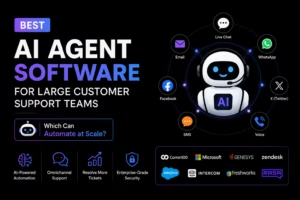
Customers no longer wait patiently in phone queues—they fire off messages on chat, email, WhatsApp, and X simultaneously. That flood of inquiries can bury even the biggest service organization. According to Gartner, 91 percent of customer-service leaders are under pressure to deploy AI this year, and most expect frontline roles to shift as automation takes over routine work.
In short, the AI agent race is no longer a “nice to have”; it is table stakes for keeping response times human-fast without endlessly expanding headcount.
We compared platforms built for true enterprise scale—tools that resolve tickets autonomously, handle millions of conversations, and still satisfy security teams. Our review covers public benchmarks, security certifications, pricing models, and real-world deployments. We then grouped each solution by the buying path you’re likely weighing so you can zero in on the software that matches your tech stack, compliance posture, and budget.
You’ll see familiar heavyweights alongside promising up-and-comers. We start with Comm100’s own AI agent software for customer service, which the company says can automate up to 80 percent of routine queries while keeping every interaction inside a SOC 2-guarded framework that can also run on-prem. That mix makes it a standout for regulated enterprises.
Here’s what to expect:
- A quick look at our evaluation criteria—so you know exactly how “best” was decided.
- Four segments that mirror common enterprise decision routes, not a one-size-fits-all ranking.
- A side-by-side table separating marketing fluff from must-know facts like deployment model and per-conversation pricing.
Use this guide to choose the AI agent that will keep your support team sharp, scalable, and future-proof.
How we picked the platforms
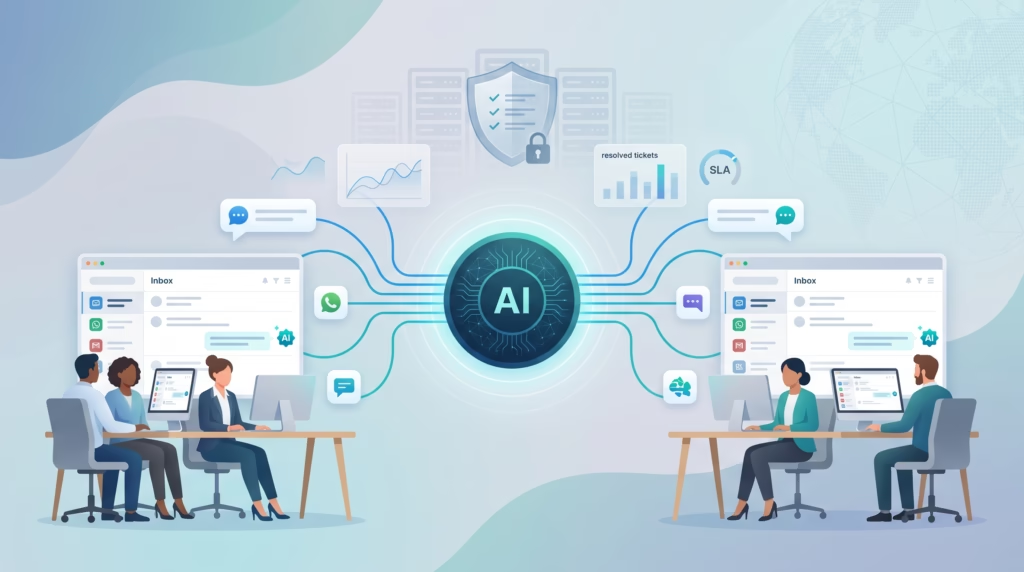
Before we examine the brands, here’s how we separated real enterprise AI agents from basic chat widgets.
First, we looked at scale. Every platform on our list runs in production for teams with hundreds of agents or millions of tickets. If a vendor limits usage to “up to 200 conversations a month,” it didn’t qualify.
Next, security. Large organizations answer to CISOs and regulators, so we required at least SOC 2 or ISO 27001 certification. Tools without a documented audit trail stayed on the bench.
We also asked a simple question: does the AI close the loop? A true agent doesn’t stop at intent detection; it resolves routine issues autonomously and passes rich context (summaries, sentiment, next-best actions) when humans need to step in. Anything less is a dressed-up FAQ bot. That test gets stricter when a single agent serves many customers rather than one: an AI agent for MSPs also needs per-tenant data isolation and a separate escalation path for each client, or context from one account surfaces in another’s ticket history.
Pricing transparency counted. Published per-resolution or seat-based costs let budget owners forecast spend instead of guessing behind a “contact sales” wall. Quote-only vendors weren’t disqualified, but we flag them so you’re not blindsided.
Finally, we checked extensibility. Open APIs, marketplace apps, or on-prem options matter when you already live inside Salesforce, Microsoft, or a custom stack. No plug-ins? No place here.
This five-point checklist kept us honest and proves every name ahead can help you automate support at scale without sacrificing trust or inflating your tech roadmap.
Compliance and data-residency specialists
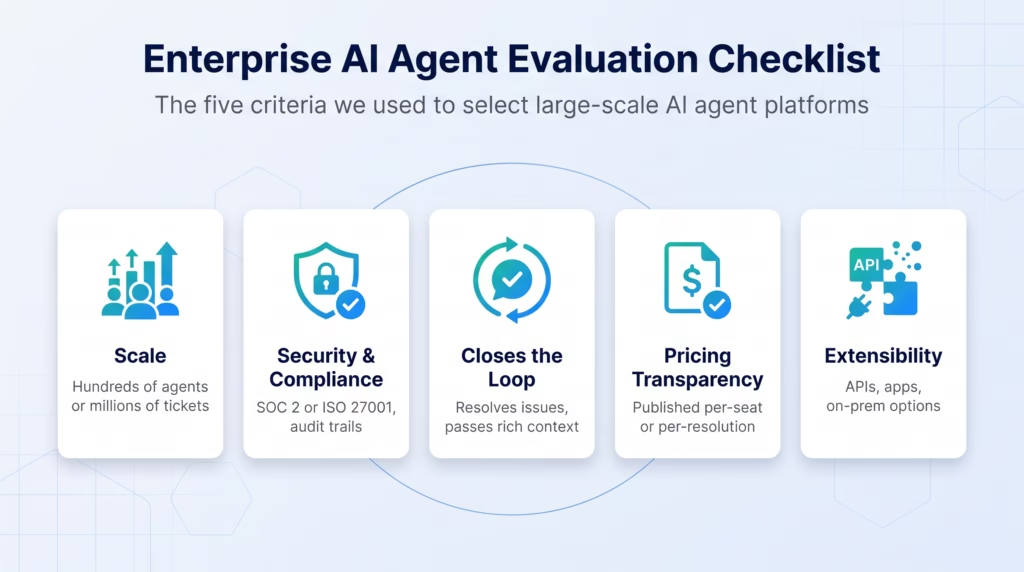
When regulators loom and data cannot cross borders, “good enough” security fails. These platforms serve public-sector, healthcare, and finance teams that audit everything and still demand five-nines reliability. We begin with the one built from the ground up for strict controls.
Comm100
Comm100 fits locked-down environments where a privacy slip could cost millions. The Vancouver-based vendor runs its entire AI Suite (chatbot, Copilot, QA, Knowledge, Insights) under SOC 2 Type II and ISO 27001 controls, and it offers an on-prem deployment option when cloud hosting is off-limits.
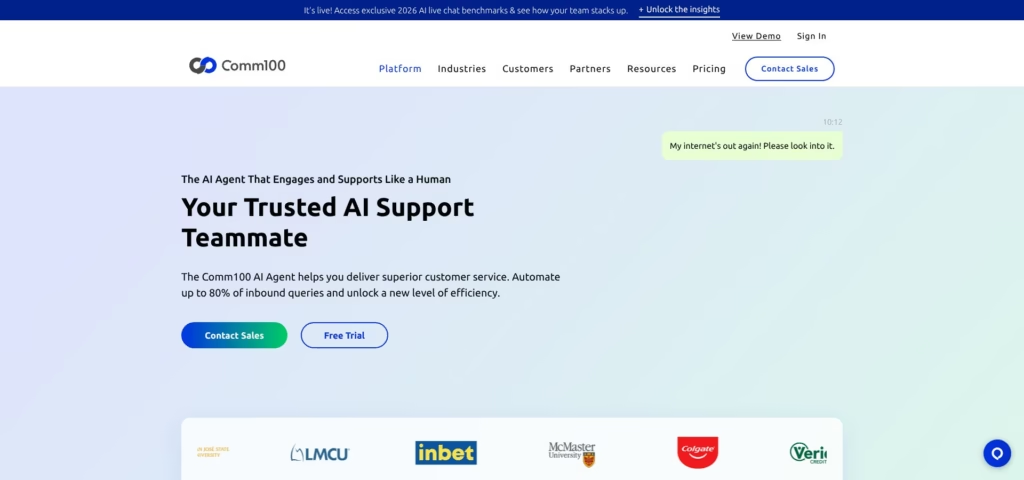
Comm100 AI Agent omnichannel console screenshot
Large universities and insurers rely on Comm100 because every channel (chat, email, SMS, social) appears in one console, so agents never juggle tabs. The AI Agent resolves roughly 80 percent of repetitive questions (self-reported), while sensitive data stays siloed; Comm100 states that “customer data is never used to train shared models,” which calms legal teams.
Add integrations with Salesforce, Microsoft Dynamics, and ServiceNow, plus HIPAA coverage with a signed BAA, and you have a platform that ticks compliance boxes without drowning admins in custom code.
Next up: Microsoft Dynamics 365 Contact Center, the default choice for organizations already all-in on Azure security services.
Microsoft Dynamics 365 Contact Center
If your organization already runs on Azure and Microsoft 365, this contact-center suite feels like a native extension rather than another silo.
Security inherits the same enterprise controls you use for email and identity management; think Azure AD SSO, customer-managed keys, and regional data residency. That shortens legal reviews and keeps the CISO satisfied.
On the automation front, Copilot-powered AI agents deflect routine tickets across chat, email, and voice. They pull live data from Dynamics CRM, so customers do not repeat order numbers or account details. When a case escalates, the agent hands off a tidy summary, shaving minutes off every transfer.
Pricing starts at $110 per user each month, and the seat license covers digital and voice channels. For teams committed to Microsoft, minimal integration work and a single-vendor support model often outweigh the higher sticker price.
Genesys Cloud CX
Genesys has long been the contact-center stalwart, and its Cloud CX platform brings that heritage to AI automation without compromising governance.
The solution runs in region-specific AWS data centers, lets you pin data to chosen geographies, and layers on PCI-DSS plus HIPAA options. You can record calls, transcribe chats, and still clear annual audits without custom workarounds.
Genesys bots manage chat, messaging, and voice, but the real strength lies in Predictive Routing. The engine studies real-time context such as customer sentiment, agent skills, and wait-time tolerance, then matches each interaction to the best human or virtual agent. Fewer blind transfers mean happier customers.
Cost follows a typical enterprise structure: named-user licenses for core CX, then AI minutes or conversation packs on top. It is not the cheapest option, yet for global banks that log every keystroke, the maturity and reporting depth justify the spend.
That closes our compliance-first picks. In the next section, we review all-in-one suites where breadth of features beats specialized controls.
All-in-one enterprise suites
When you want one contract, one data model, and one admin console, a full-stack suite is the simplest path. These platforms pack ticketing, knowledge, analytics, and AI automation into a single subscription, so you spend less time stitching tools together and more time lifting CSAT.
Zendesk autonomous service workforce
Zendesk’s latest release turns its familiar helpdesk into an AI-first engine. At the center is Agent Builder, which creates chat, email, and social agents in minutes by training on your existing help-center articles. The agents escalate to live reps with a concise summary and suggested macros, so no one starts from scratch.
Zendesk autonomous service workforce Agent Builder page screenshot
For managers, Outcome-Based Pricing stands out: you pay by resolution, not by seat, aligning cost directly with automation performance. The same AI powers routing, tone adjustment, and real-time sentiment dashboards, giving leaders a live view of queue health.
Compliance is lighter than in the previous group, but SOC 2 and GDPR coverage satisfy most corporate standards. If your support operation already runs in Zendesk, activating the autonomous service workforce feels more like flipping a switch than managing a migration.
Salesforce Agentforce
Service Cloud users now have an AI agent that speaks fluent Salesforce. Agentforce taps into the same data graph that powers your sales, marketing, and billing teams, so support interactions reflect the full customer story in real time.
The agent resolves routine questions such as order status, subscription changes, and password resets by calling Flows you already built in Process Builder. When escalation is required, it lands in the agent’s console with a one-click recap and suggested next actions, cutting handle time without reinventing workflow.
Pricing is straightforward at $2 per conversation or via Flex Credits, a model finance teams appreciate because cost scales with ticket load, not seat count. For global deployments, Agentforce inherits Salesforce’s regional hosting and comprehensive compliance portfolio, including HITRUST and PCI.
If your organization is already all-in on the CRM, Agentforce keeps everything under one roof and lets you launch AI support without exporting a single record.
Freshworks Freddy AI
Freshdesk’s approachable branding comes with a deep AI stack. Freddy now covers self-service bots, agent assist, auto-triage, and post-interaction analytics, all managed from the same Freshworks admin panel you use for tickets and chat.
Setup is quick: feed Freddy your help-center articles, map a few intents, and the bot starts resolving common queries within hours. On the agent side, Smart Reply suggests answers in real time and drafts follow-ups that match your brand tone. Managers get User Journey Reports that chart containment rates and highlight where human expertise still matters.
Pricing begins with base seats such as Freshdesk Omni Pro at $79 a month. AI extras cost more: Freddy AI Copilot runs $29 per agent, and the autonomous AI Agent is billed by usage (for example, $49 per 100 sessions), so costs scale with automation volume. For mid-market teams seeking enterprise-grade automation without drawn-out price negotiations, Freshworks offers a balanced mix of power and approachability.
Outcome-based platforms
Paying for software seats when bots do the heavy lifting feels backward. Outcome-based vendors charge only when the AI closes a conversation. Finance teams can tie cost directly to automation lift, and managers can chase higher containment without worrying about per-agent license creep.
Intercom Fin 3
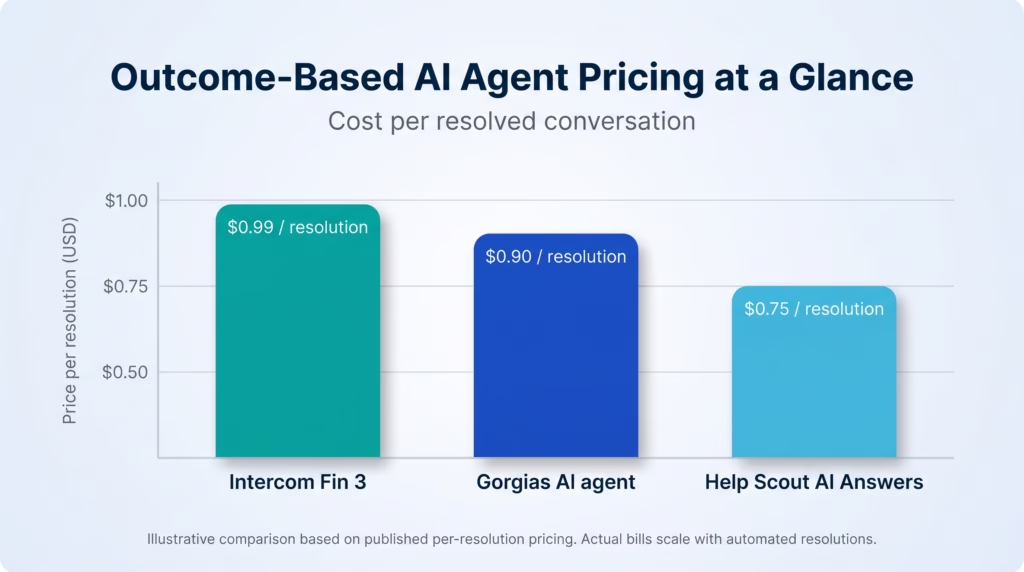
Fin set the bar for pay-per-resolution pricing and continues to raise it. The latest version includes Procedures, which let you define step-by-step actions such as checking order status, resetting a password, or canceling a subscription without writing code. Each completed flow counts as one billable resolution at $0.99, making ROI math clear.
Fin trains on your help-center content in minutes and supports 45 languages out of the box. When the AI reaches its limit, it hands the thread to an agent with a concise summary and sentiment score, sparing customers from repeating themselves.
At scale, teams value the certainty: 50,000 automated resolutions equal $49,500, with no surprises. If transparency and rapid deflection top your wish list, Fin delivers enterprise-level polish without enterprise-level guesswork.
Gorgias AI agent
E-commerce support faces constant pressure; customers expect order answers now, not “within 24 hours.” Gorgias meets that urgency and prices its AI Agent at $0.90 per resolved conversation, making cost per ticket easy to track.
Because Gorgias connects directly to Shopify, BigCommerce, and WooCommerce, the bot can pull order data, initiate refunds, and process exchanges mid-chat. That actionability turns what could be a multistep email thread into a 60-second self-service win. Agents see the same context, so if a case escalates they pick up exactly where the bot stopped.
Brands focused on revenue attribution value the dashboard that links automated support to repeat purchases and recovered carts. When the CFO asks, “Did automation improve revenue?” you will have the answer in dollars, not anecdotes.
Help Scout AI Answers
If you run a lean support team and need automation without a six-figure contract, AI Answers is the budget standout. Every resolved conversation costs just $0.75, and there’s no minimum commitment, making it ideal when volume swings with seasonality.
Because AI Answers pulls directly from your Docs knowledge base, setup is as simple as pointing the bot at existing articles. Within hours it fields routine “how do I” questions, freeing agents for higher-touch issues. When escalation happens, the transcript appears in the same shared inbox Help Scout is known for, so nothing slips through the cracks.
Plans start at $25 per user each month, keeping the total bill manageable even as volume grows. For small-to-mid sized teams that want enterprise-grade polish without enterprise pricing, AI Answers balances cost control and customer satisfaction.
Build-flex and open architecture
Sometimes an off-the-shelf bot does not fit your workflow, data rules, or brand voice. Open platforms let you host models, wire in custom actions, and shape governance to the letter. They require more engineering effort up front, but they give full control over data, latency, and roadmap.
Rasa Orchestrator
Rasa is a leading open-source stack for enterprises that want to keep AI logic on their own infrastructure. The new Orchestrator layer routes every message to the appropriate large language model or rules engine, so you can blend proprietary models with vendor APIs without exposing customer data.
Because the entire pipeline runs on your servers or private cloud, latency stays predictable and compliance audits become as simple as reading your own logs. Pre-built connectors cover Slack, WhatsApp, and web chat, while custom actions can call any internal microservice such as order lookups, claim status, or patient records.
Licensing is straightforward: the core framework is free, and enterprise support starts at a flat annual fee that covers security patches and architectural guidance. For organisations with strong DevOps skills and strict data-residency rules, Rasa offers flexible control without a per-conversation tax.
Nvidia NeMoClaw
Open-source agent frameworks like OpenClaw took off on GitHub, but most lacked the reliability enterprises need. Nvidia stepped in with NeMoClaw, a hardened distribution that adds GPU-optimized inference, enterprise logging, and RBAC to the original project.
NeMoClaw installs behind your firewall, so sensitive chat data never leaves your VPC. A visual policy builder lets architects set guardrails to define which actions an agent can trigger in SAP or Salesforce before code reaches production. Because the stack runs on Nvidia TensorRT servers, response latency holds under 100 ms during peak traffic, so voice and chat feel instant.
Licensing stays simple: the core NeMoClaw framework is open source and free, so you pay only for the compute infrastructure you select. For teams seeking open-source freedom with vendor-backed confidence, NeMoClaw provides a balanced option between DIY and SaaS.
Sendbird agent steward
Sendbird built its name on developer-friendly chat APIs, and Agent Steward brings the same approach to AI automation. Instead of a black-box bot, Steward exposes every decision step (classification, knowledge fetch, action trigger) in the dashboard, allowing product teams to inspect and adjust logic without digging through logs.
A notable feature is Undo & Override. Customers can reverse an AI action, such as an order cancellation or address change, with a single tap, and Steward rolls back the API call. That safety net boosts user trust and reduces the “please fix your bot’s mistake” tickets human agents dread.
Pricing is usage-based: you pay per conversation, with custom volume tiers for enterprise deployments. Because the core platform already runs inside many mobile apps, adding Steward to an existing Sendbird setup usually takes days, not months, which is a welcome change from typical enterprise timelines.
Quick-glance comparison
Choosing a platform is easier when the must-know facts live in one place. Use the table below to spot hard constraints such as deployment model, compliance level, and pricing trigger before you jump into demos.
| Platform | Core channels | Self-hosted | Key compliance | Pricing model | Notable customers |
| Comm100 | Chat, email, social, SMS | Optional on-prem | SOC 2, ISO 27001, HIPAA | Quote (AI Suite) | Stanford, AXA |
| Microsoft Dynamics 365 CC | Voice, chat, email | No | SOC 1/2, GDPR | $110 / user / mo | NHS, IKEA |
| Genesys Cloud CX | Voice, chat, social | No | PCI-DSS, HIPAA add-on | Licenses + AI mins | PayPal, Vodafone |
| Zendesk AI workforce | Chat, email, social | No | SOC 2 | Per-resolution or tier | Uber, Shopify |
| Salesforce Agentforce | Chat, email, voice | No | HITRUST, PCI | $2 / conversation | AWS, Delta |
| Freshworks Freddy | Chat, email, phone | No | SOC 2 | Seats + per-session | Klarna, Bridgestone |
| Intercom Fin 3 | Chat, email | No | SOC 2 | $0.99 / resolution | Atlassian, Notion |
| Gorgias AI agent | Chat, email, social | No | GDPR | $0.90 / resolution | Gymshark, MVMT |
| Help Scout AI answers | Chat, email | No | SOC 2 | $0.75 / resolution | Basecamp |
| Rasa Orchestrator | Any via API | Yes | Depends on host | Annual support fee | Deutsche Bahn |
| Nvidia NeMoClaw | Any via API | Yes | Depends on host | Open source (free) | Pilot deployments |
| Sendbird agent steward | Mobile, web, voice | No | SOC 2 | Per conversation | Korea Air |
We kept the columns tight, listing only the facts that often decide a shortlist. If two vendors check every box, examine agent accuracy, reporting depth, and integration effort in a proof-of-concept; those nuances rarely fit a table.
Emerging trends to watch
Outcome-based billing and eye-catching copilots get the headlines, but three undercurrents will shape enterprise support over the next 18 months.
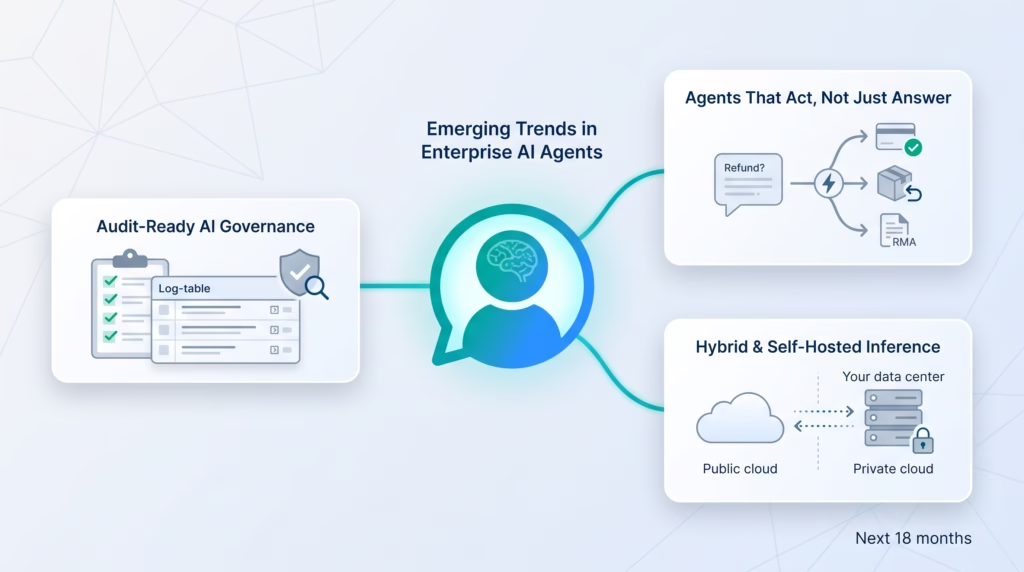
First, AI governance is moving from slide decks to audits. Boards want proof that bots respect privacy rules and avoid biased outcomes. Look for vendors to offer audit-trail APIs, differential-privacy toggles, and red-team simulators built into admin consoles.
Second, language models are learning to act, not just answer. Agent frameworks now trigger refunds, reship orders, or create RMAs inside core business systems. That shift calls for tighter role-based controls and rollback options, the same safeguards visible in Sendbird’s Undo flow and Intercom’s Procedures.
Finally, hybrid deployment is returning. Organisations that once swore off data centers are testing self-hosted inference so customer data never enters a shared cloud. Nvidia’s NeMoClaw and Rasa’s Orchestrator stand at this intersection, blending open models with enterprise guardrails.
Conclusion
There is no single best AI agent, only the best fit for your buying path. Compliance-bound teams gravitate to Comm100 or Genesys, all-in-one shops to Zendesk or Salesforce, cost-watchers to per-resolution tools like Intercom Fin, and control-focused engineers to open stacks like Rasa. Match the platform to your stack and compliance needs, then pilot against tomorrow’s actionability and hosting demands.