
Paying people correctly starts with knowing how many hours they worked. When hours live in spreadsheets, chat messages, or memory, mistakes creep in. Payroll takes longer, disputes follow, and client invoices for billable time become harder to back up.
Time tracking software fixes this by capturing hours automatically and keeping attendance, breaks, projects, and timesheets in one place. Many tools also add activity reports, app and website usage, and screenshots for teams that want extra context.
The challenge is picking a tool that fits. Some platforms focus on simple hours and payroll, others on analytics, security, or scheduling. This guide compares eight options on features, pricing, and practical use.
Quick Overview
Apploye is the best all-round choice for most teams. It tracks work hours, attendance, active and idle time, screenshots, apps, URLs, projects, and timesheets. Paid plans add a real-time active view and detailed reports.
Its Starter plan is free for up to 10 users and covers the essentials: time tracking, attendance, screenshots, activity analytics, app and URL tracking, timesheets, and projects. When you need more, the Elite plan starts at $4.50 per user/month with annual billing. It adds deeper activity tracking, real-time views, payroll, invoicing, custom reports, and integrations.
How the others differ:
- WorkTime tracks hours without screenshots or recordings.
- Teramind offers deeper activity and security controls.
- Insightful and ActivTrak focus on workforce analytics.
- Time Doctor pairs time tracking with productivity reports.
- Hubstaff adds scheduling, payroll, and a dedicated call center solution.
- KeepActive is a lower-cost option.
The 8 Best Employee Time Tracking Software Tools
We compared the following tools on time tracking accuracy, attendance, timesheets, payroll features, activity reports, screenshots, app and website tracking, and pricing.
Here is the comparison table, built only from what your article says. Place it after the KeepActive section and before “How to Choose Employee Time Tracking Software.”
Here is the comparison table, built only from what your article says. Place it after the KeepActive section and before “How to Choose Employee Time Tracking Software.”
| Tool | Best for | Free plan | Starting price | Screenshots | Payroll | Standout features |
| Apploye | Accurate hours and payroll | Yes, up to 10 users | $4.50/user/month (Elite, annual) | Yes (limited on free plan) | Yes (paid plans) | Timesheets and approvals, attendance, client invoicing, billable time |
| WorkTime | Screenshot-free tracking | Yes, up to 3 employees | $6.99/employee/month (Basic) | No | Not mentioned | Active and idle time, login and logout activity, app and website use |
| Teramind | Advanced activity and security controls | Not listed | Custom pricing (min. 5 seats) | Screen recording | Not mentioned | Live views, behavior rules, data loss prevention, digital forensics |
| Insightful | Workforce analytics | Not listed | $8/seat/month (Workforce Analytics, annual) | Yes (more through extra options) | Not mentioned | Capacity analysis, schedule adherence, real-time workforce views |
| ActivTrak | Productivity and utilization insights | Yes, up to 3 people | $10/worker/month (Work Activity Tracking) | Not mentioned | Not mentioned | Utilization and capacity dashboards, application usage |
| Time Doctor | Detailed time tracking and timelines | Not listed | $6.67/user/month (Basic, annual) | Yes | Higher plans | Timeline reports, scheduling, leave and break tracking |
| Hubstaff | Scheduling and payroll | Not listed | $4.99/seat/month (Starter, annual) | Yes | Yes | Scheduling, call center solution, support ticket time tracking |
| KeepActive | Budget option | Not listed | $2.75/user/month (Time Tracking, annual) | Yes (configurable) | Not mentioned | Online, idle, and offline status, live views, productivity reports |
1. Apploye: Best Overall for Accurate Hours and Payroll
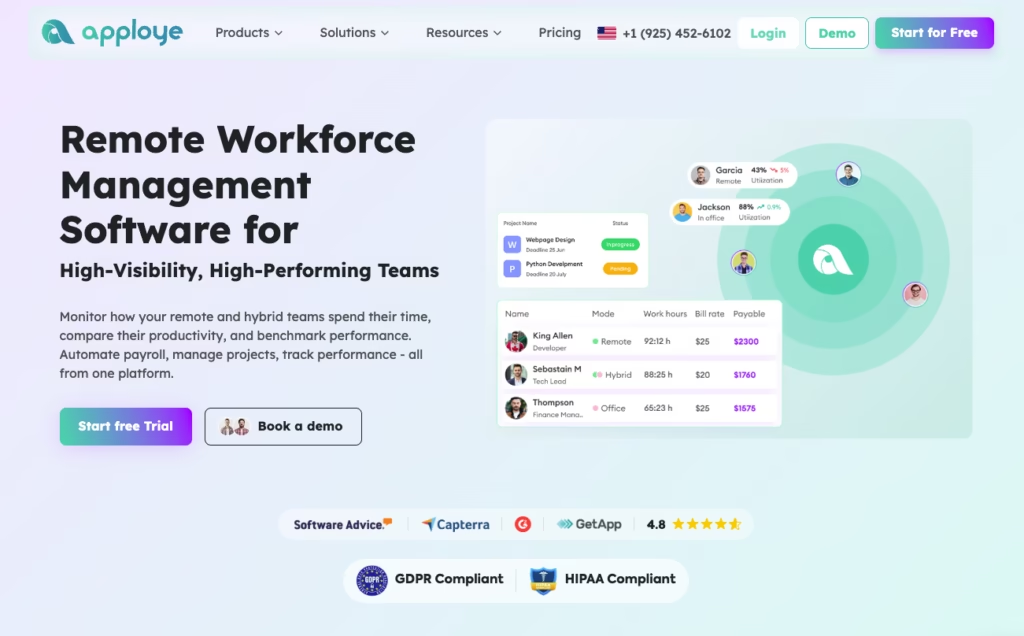
Apploye brings time tracking, attendance, timesheets, payroll, and client billing into one platform. So, your management teams don’t need separate tools for each job.
It records total work time, active time, idle time, attendance, screenshots, apps, URLs, activity levels, projects, tasks, and timesheets. On paid plans, the real-time active view shows who is working right now.
For payroll, this means managers can review tracked hours, approve timesheets, and pay from the same records. Apploye also works as time tracking software for consultants, supporting billable and non-billable time for agencies, outsourcing companies, and service teams that bill clients by the hour.
Payroll and timesheet tools cut the manual work of preparing payments.
Best features of Apploye
- Time tracking
- Attendance and leave tracking
- Active and idle time
- Screenshots
- App usage tracking
- URL tracking
- Activity analytics
- Real-time active view
- Timesheets and approvals
- Project and task tracking
- Custom reports
- Payroll
- Client invoicing
- Integrations
- Billable and non-billable time
Pricing
- Starter: Free forever for up to 10 users
- Elite: $4.50/user/month, billed annually
- Power: $8/user/month, billed annually
- Enterprise: Custom pricing
Pros
- Free plan supports up to 10 users
- Combines time tracking, timesheets, and activity reports
- Supports payroll and client billing
- Useful for remote, hybrid, and outsourced teams
- Paid plans add deeper tracking and reporting
Cons
- The free plan limits screenshots, app tracking, URL tracking, and data history
- Screen recording is an add-on, not a standard feature
Best for: Small businesses, agencies, remote teams, outsourcing companies, and support teams that need accurate work hours, timesheet approvals, payroll, or client billing.
2. WorkTime: Best for Screenshot-Free Tracking
If the idea of capturing your team’s screens makes you uneasy, WorkTime offers a lighter approach. It tracks activity without screenshots, screen recordings, or keystroke data. Instead, you get active and idle time, attendance, login and logout activity, and app and website use.
That makes it a good fit when you want accurate hours and still want your team to feel trusted. Its reports help you review attendance, active time, and productivity without getting into anyone’s screen.
WorkTime has a free plan for up to three employees, so you can try it before you commit. Basic costs $6.99 per employee/month, and Premium costs $8.99. Enterprise starts at $10.99.
3. Teramind: Best for Advanced Activity and Security Controls
If your business handles sensitive data, you probably worry about more than hours worked. Teramind is built for that situation.
It tracks websites, applications, user activity, and screen activity through the workday, so you can see what is happening with your data.
You also get screen recording, live views, behavior rules, and digital forensics. Higher plans add data loss prevention, sensitive content detection, and insider threat features.
These controls go well beyond a basic time tracker, so they can feel like a lot. Before you turn on advanced features, review your workplace and privacy rules. Tell your team what is being tracked and why. Being open about it protects trust and helps people accept the tool.
Teramind uses custom pricing. Plans are Starter, UAM, DLP, and Enterprise, and standard plans require at least 5 seats.
4. Insightful: Best for Workforce Analytics
If you want to understand how your team spends its time, not just count hours, Insightful is worth a look. It goes beyond basic time tracking into workforce analytics. You get real-time workforce views, capacity analysis, app and website usage, screenshots, attendance, active and idle time, and schedule adherence.
These tools help you see where workloads are uneven and where productivity may be slipping, so you can fix the cause instead of guessing. It also includes workforce planning and workflow optimization features to help you plan ahead.
Workforce Analytics costs $8 per seat/month with annual billing. Workflow Optimization is $12 per seat/month, and the Combo plan is $16. Enterprise pricing is custom. Screenshots and screen recording are available through additional options.
5. ActivTrak: Best for Productivity and Utilization Insights
Knowing how many hours people worked is useful. Knowing how well those hours are used is better. ActivTrak is built for that second question. It helps you connect employee activity with wider workforce performance data.
You can review activity, application usage, utilization, and capacity. Dashboards help you spot workload gaps and understand how your team’s time is spent, which makes it easier to support people who are stretched thin.
This makes ActivTrak a good pick if you want to measure workforce efficiency, not just hours worked.
ActivTrak has a free plan for up to three people, so you can start small. Work Activity Tracking costs $10 per worker/month, Workforce Management costs $15, and Productivity Optimization costs $17.
6. Time Doctor: Best for Detailed Time Tracking and Timelines
If you like having the full picture, Time Doctor delivers it. It combines time tracking with screenshots, attendance, app and website reports, scheduling, breaks, and productivity features. You get a detailed view of your team’s hours and activity.
Plans include automatic time tracking, timeline reports, projects and tasks, screenshots, and online and offline tracking. Higher plans add attendance, payroll, scheduling, leave and break tracking, and app and website reports.
When payday comes, these records help you review hours across shifts and teams before you pay, so you can feel confident the numbers are right.
Basic costs $6.67 per user/month with annual billing. Standard is $11.67, and Premium is $16.70. Enterprise pricing is custom.
7. Hubstaff: Best for Scheduling and Payroll
If you manage shifts, schedules, and payments, Hubstaff can take a lot of the weight off your shoulders. It pairs time tracking with activity data, workforce analytics, payroll, and scheduling in one place.
You can track time, activity levels, app usage, screenshots, attendance, breaks, and schedules. Hubstaff also offers a dedicated call center solution and supports time tracking for support tickets through integrations, which helps if your team handles customer support.
Its tools are built to connect your team’s tracked work time with scheduling and payment, so you spend less time piecing records together.
Starter costs $4.99 per seat/month with annual billing. Grow is $7.50, Team is $10, and Enterprise is $25.
8. KeepActive: Best Budget Option
If you are watching your budget, you don’t have to give up useful features. KeepActive combines time tracking with productivity analysis, project tracking, app and website tracking, and visual activity views. It also includes attendance, activity history, screenshots, and real-time status features.
You can see whether team members are online, idle, or offline and review activity across the day. Newer features include configurable screenshots, live views, offline activity, and productivity reports.
It is an affordable way to track your team’s work time and activity. Keep in mind that its focus is more on productivity than on payroll depth, so check that it covers what you need before you choose it.
The Time Tracking plan costs $2.75 per user/month with annual billing. Employee Monitoring costs $5.50, and Data Loss Protection costs $11.
How to Choose Employee Time Tracking Software
The right tool depends on your team size, how you pay people, and the systems you already use.
- Check time and attendance accuracy. Start with reliable work hours. You should be able to see when people start, stop, take breaks, and finish. Attendance reports also help catch missed shifts and late arrivals.
- Look at timesheets and approvals. Timesheet approvals give managers a chance to check hours before payment. This step prevents most payroll errors and disputes.
- Consider payroll features. Some tools only record hours. Others calculate pay and export data to payroll systems. Check which one you need before you commit.
- Check billable-hour and invoicing tools. If you bill clients for your team’s time, look for billable and non-billable tracking, project and task tracking, and invoicing.
- Review active and idle time. Activity data shows how tracked hours are used. It is most useful when read alongside workload and schedule information.
- Review screenshot and privacy controls. Screenshots add visual context, but not every team needs them. Check screenshot frequency, privacy settings, storage history, and whether employees can see when tracking is on.
- Check app and website tracking. App and URL data shows which tools take the most time. It can reveal workflow problems, software your team doesn’t need, or time lost to social media, which employee social media monitoring software can help you review.
- Look for scheduling, shift, and break tracking. If you run fixed or rotating shifts, break and schedule tracking lets you compare planned schedules with actual attendance.
- Check reporting. Good reports cover individual employees, teams, projects, and departments. Look for work time, attendance, activity, productivity, and utilization.
- Calculate the total cost. Look beyond the starting price. Check user minimums, screenshot limits, reporting restrictions, add-ons, payroll features, and billing terms. A cheap plan can cost more once you add the features you need.
Read More:
Frequently Asked Questions
What is the best employee time tracking software?
Apploye is a strong overall choice. It combines time tracking, attendance, timesheets, activity reports, payroll, and client billing.
What should employee time tracking software cover?
It should cover work hours, attendance, breaks, timesheets, and approvals. Active and idle time, application use, and screenshots can add useful context.
Can time tracking software help with payroll?
Yes. Accurate hours and approved timesheets reduce manual work and errors. Apploye also includes payroll tools on paid plans.
Can it track idle time?
Yes. Apploye, WorkTime, Insightful, and others report active and idle periods, which helps managers see how logged hours are used.
What is the best free employee time tracking software?
Apploye offers a free plan for up to 10 users. It includes time tracking, attendance, screenshots, limited app and URL tracking, activity analytics, timesheets, and projects.
Is there time tracking software that doesn’t use screenshots?
Yes. WorkTime tracks activity without screenshots, screen recordings, or keystroke data.
How much does employee time tracking software cost?
Prices range from free plans to custom enterprise pricing. Apploye starts free for up to 10 users, and paid options vary with the depth of tracking and payroll features.
Read More: Why Is a Mobile App Crucial for Tool Tracking Software?
Final Note
Accurate work hours are the base of fair, on-time payroll. But hours alone are not enough. Teams also need attendance, approved timesheets, and, in many cases, activity reports and client billing.
Apploye brings these together with time tracking, screenshots, app and URL tracking, activity analytics, attendance, timesheets, payroll, and client invoicing. Its free plan supports up to 10 users, so smaller teams can start without paying.
The other tools serve different needs. WorkTime offers screenshot-free tracking. Teramind adds deeper security and activity controls. Insightful and ActivTrak lean toward workforce analytics. Time Doctor focuses on detailed time tracking, Hubstaff adds scheduling and payroll, and KeepActive is the lower-cost option.
The right choice depends on how much detail your team needs and how you handle payroll and billing today.