
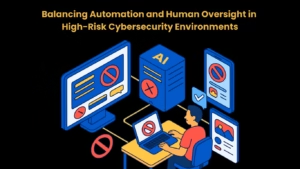
The Growing Complexity of Cybersecurity Threats
In today’s digital landscape, cybersecurity threats have become increasingly sophisticated and frequent. High-risk environments, such as financial institutions, healthcare providers, and critical infrastructure, face persistent attacks that can lead to severe consequences, including financial loss, reputational damage, and regulatory penalties. According to IBM’s Cost of a Data Breach Report 2023, the average cost of a data breach reached $4.45 million globally, underscoring the urgent need for robust cybersecurity measures.
With the surge in cyber threats, organizations are turning to automation to enhance their security posture. Automation tools can rapidly detect anomalies, respond to incidents, and manage routine security tasks, thus reducing response times and minimizing human error. However, the reliance on automation alone is not sufficient in high-risk environments where nuanced decision-making and contextual understanding are critical. Striking the right balance between automated systems and human oversight is essential for effective cybersecurity defense.
The Role of Automation in High-Risk Cybersecurity
Automation brings several advantages to cybersecurity operations. It can handle repetitive tasks such as log analysis, vulnerability scanning, and patch management with greater speed and consistency than human operators. For instance, Security Orchestration, Automation, and Response (SOAR) platforms enable organizations to automate the triage and remediation of security alerts, significantly reducing the workload on security teams.
Moreover, automation can provide 24/7 monitoring capabilities, which are vital for detecting threats in real-time. According to a report by Cybersecurity Ventures, cybercrime is expected to cost the world $10.5 trillion annually by 2025, emphasizing the necessity for continuous threat monitoring. Automation helps organizations keep pace with the volume and velocity of cyber threats that human analysts alone cannot manage efficiently.
To maximize the benefits of automation, many organizations collaborate with specialized service providers. For example,compasscomputergroup.com offers tailored solutions that integrate advanced automation tools with expert human oversight, ensuring that automated processes are continuously refined and validated by cybersecurity professionals.
Why Human Oversight Remains Crucial
Despite the power of automation, human expertise remains indispensable in high-risk cybersecurity environments. Automated systems can generate false positives or miss subtle attack indicators that require contextual analysis. Skilled cybersecurity professionals bring critical thinking, intuition, and adaptive learning capabilities that machines currently lack.
Humans are particularly important in threat hunting, incident response, and strategic decision-making. While automation can flag suspicious activities, human analysts assess the broader implications, determine the intent behind attacks, and decide on the most appropriate containment and recovery measures. This synergy between man and machine creates a more resilient defense.
Furthermore, regulatory compliance often necessitates human involvement in cybersecurity governance. Frameworks like the NIST Cybersecurity Framework and GDPR require documented processes and accountability that automated systems alone cannot fulfill. IT firms like Compeint emphasize the importance of combining automated tools with experienced personnel to meet compliance requirements while maintaining robust security.
Challenges in Integrating Automation with Human Oversight
Although blending automation and human oversight is beneficial, it presents implementation challenges. One significant hurdle is achieving seamless communication between automated platforms and security teams. Without clear workflows and interfaces, critical alerts might be overlooked or delayed.
Another challenge is maintaining the right level of automation. Over-automation can lead to alert fatigue, where security analysts become overwhelmed by the volume of notifications, reducing their effectiveness. Conversely, under-automation may leave security teams bogged down by mundane tasks, preventing them from focusing on strategic initiatives.
Training and skill development are also vital. Cybersecurity professionals must be adept at interpreting automated outputs and adjusting system parameters. Organizations need to invest in continuous education to keep their teams updated on evolving threats and automation technologies.
Best Practices for Balancing Automation and Human Oversight
To effectively balance automation and human oversight in high-risk cybersecurity environments, organizations can adopt several best practices:
- Define Clear Roles and Responsibilities: Establish which tasks are automated and which require human intervention. This clarity helps prevent gaps and overlaps in security coverage.
- Implement Tiered Alert Systems: Use automation to filter and prioritize alerts by severity, allowing human analysts to focus on high-impact incidents.
- Regularly Review and Update Automation Rules: Automated systems should be continuously fine-tuned based on feedback from human operators and emerging threat patterns.
- Invest in Skilled Personnel: Recruit and train cybersecurity professionals capable of interpreting complex data and making informed decisions.
- Leverage Collaborative Platforms: Use integrated cybersecurity platforms that facilitate seamless communication between automated tools and human teams.
- Maintain Compliance and Documentation: Ensure that all automated and manual processes adhere to regulatory standards and are well documented.
Expanding on these best practices, organizations should also consider establishing cross-functional teams that include members from IT, legal, and risk management departments. Such collaboration ensures that cybersecurity strategies align with broader business objectives and regulatory requirements. Additionally, conducting regular simulations and tabletop exercises can help both automated systems and human teams prepare for coordinated responses to complex attack scenarios.
The Impact of Hybrid Cybersecurity Models: Statistics and Trends
The evolving cybersecurity landscape has accelerated the adoption of hybrid models that combine automation with human oversight. A recent survey by Gartner found that by 2026, 70% of organizations will integrate AI-driven cybersecurity tools with human expertise to improve threat response efficiency. This trend highlights the ongoing evolution towards a hybrid model that leverages the strengths of both automation and human insight.
Moreover, research from Ponemon Institute reveals that companies employing a balanced approach to cybersecurity—combining automation with skilled human intervention—reduce the average time to identify and contain breaches by 27% compared to those relying primarily on manual processes. This reduction translates into significant cost savings and mitigates reputational risks.
Additionally, a Cybersecurity and Infrastructure Security Agency (CISA) report indicates that organizations with mature automation and oversight frameworks experience 50% fewer successful cyberattacks, illustrating the effectiveness of this integrated approach. These statistics underscore the tangible benefits of harmonizing technology with human expertise.
Future Outlook: Enhancing Cybersecurity through Human-Automation Collaboration
Looking ahead, advancements in artificial intelligence (AI) and machine learning (ML) will further enhance automation capabilities, enabling more accurate threat detection and predictive analytics. However, the human element will remain vital for ethical considerations, strategic oversight, and managing unforeseen scenarios.
Emerging technologies such as explainable AI (XAI) aim to make automated decisions more transparent, helping human analysts understand the rationale behind alerts and recommendations. This transparency will foster greater trust and more effective collaboration between automated systems and cybersecurity professionals.
Furthermore, the increasing adoption of zero trust security models demands continuous verification and adaptive responses—tasks that blend automated monitoring with human judgment. As cyber threats become more dynamic and complex, organizations must adapt their security frameworks to maintain agility and resilience.
Organizations operating in high-risk cybersecurity environments should proactively embrace this integrated approach. By doing so, they can build resilient defenses that adapt to the dynamic threat landscape while optimizing resource allocation and maintaining compliance.
Read More: Balancing Automation and Human Oversight in Data Protection Amidst Rapid IT Expansion
Conclusion
Balancing automation and human oversight is no longer optional but a strategic imperative for organizations facing high-risk cybersecurity challenges. Automation accelerates threat detection and response, while human expertise ensures contextual understanding, nuanced decision-making, and compliance adherence.
As cyber threats continue to evolve, organizations must invest in both cutting-edge automation technologies and skilled cybersecurity professionals. This balanced approach will empower them to navigate complex threats effectively, safeguard critical assets, and maintain stakeholder trust in an increasingly interconnected world.
By fostering a culture that values both technological innovation and human insight, organizations can establish a cybersecurity posture that is both proactive and resilient. The future of cybersecurity lies in this harmonious balance—where automation enhances human capabilities, and human judgment guides automation to protect against the ever-changing cyber threat landscape.