
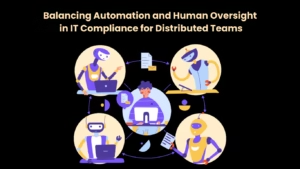
The Rise of Distributed Teams and IT Compliance Challenges
As businesses continue to embrace remote work and distributed teams, IT compliance has become an increasingly complex challenge. Organizations must ensure that their data security, privacy, and regulatory requirements are met consistently across diverse locations, often with limited centralized control. According to a Gartner report, by 2024, 30% of large enterprises will have adopted distributed workforce models, making compliance management more critical than ever.
Distributed teams introduce variability in how IT policies are implemented, increasing the risk of non-compliance. Different time zones, cultural norms, and local regulations can create a patchwork of compliance efforts that are difficult to harmonize. Businesses face the dual imperative of leveraging automation to maintain efficiency and scalability while also applying human oversight to address context-specific nuances and ensure ethical governance. This balance is crucial because failure to comply with regulations such as GDPR, HIPAA, and others can lead to severe penalties, loss of reputation, and operational disruptions.
Organizations like ACC Tech specialize in providing tailored IT compliance services that blend technology and human expertise. Their approach underscores the importance of having knowledgeable personnel oversee automated systems to maintain compliance integrity, especially in distributed environments where uniform policy enforcement is challenging. With remote work becoming a permanent fixture in many industries, companies must rethink their compliance strategies to accommodate this new landscape.
Leveraging Automation in IT Compliance
Automation technologies have revolutionized how organizations approach IT compliance. Automated tools can continuously monitor systems for vulnerabilities, enforce policy adherence, and generate compliance reports without the need for manual intervention. This reduces human error and frees up IT personnel to focus on higher-value tasks. Automation also facilitates scalability, allowing compliance processes to keep pace with organizational growth and the expanding attack surface of distributed teams.
For example, automated compliance management platforms can scan endpoints across multiple geographic locations, detect unauthorized software, and flag irregularities in real time. This capability is vital for distributed teams, where IT administrators cannot physically oversee every device or user activity. Automation also enables faster response times; security incidents can be detected and remediated promptly, reducing potential damage.
A survey by McKinsey found that companies using automation in compliance processes experienced a 40% reduction in compliance costs and a 45% improvement in issue resolution time. Furthermore, automation can enhance audit readiness by maintaining comprehensive logs and documentation, which are essential for demonstrating compliance during regulatory reviews.
Despite these advantages, automation is not a silver bullet. Automated systems may struggle with nuanced compliance decisions, such as evaluating the intent behind certain user behaviors or adapting to rapidly changing regulatory requirements. They can also generate false positives or overlook context-specific risks, leading to either unnecessary alerts or missed violations. Therefore, automation must be integrated thoughtfully with human expertise to interpret complex scenarios and make judgment calls.
The Role of Human Oversight in Ensuring Compliance Integrity
While automation handles routine and repetitive tasks, human oversight remains indispensable. Skilled compliance professionals understand organizational context, legal frameworks, and ethical considerations that machines cannot fully grasp. They can assess ambiguous situations, respond to unforeseen risks, and adapt policies dynamically.
Human oversight is particularly important in managing exceptions, investigating compliance incidents, and communicating with stakeholders. Distributed teams benefit from compliance officers who can bridge cultural and operational gaps, ensuring policies are not only enforced but also embraced. This human element fosters a culture of compliance, which is vital for long-term success.
Moreover, compliance experts play a critical role in interpreting regulatory updates and translating them into actionable policies. They can tailor compliance strategies to specific business units and geographic regions, considering local laws and cultural norms. This adaptability ensures that compliance efforts remain effective and relevant.
When choosing to evaluate managed IT services, they emphasized the importance of a hybrid model that leverages automation for scalability while retaining human oversight to navigate complexities. This balance is particularly vital in distributed environments where compliance risks can vary widely depending on location and operational context. The combination of automated monitoring with human judgment creates a more resilient compliance framework capable of responding to both predictable and unexpected challenges.
Integrating Automation and Human Oversight Effectively
Successfully balancing automation and human oversight requires a strategic approach. First, organizations should identify which compliance tasks are best suited for automation—such as routine audits, data collection, and policy enforcement. These tasks are often high-volume and rule-based, making them ideal candidates for automated processes that can operate continuously without fatigue.
Next, they must delineate responsibilities where human judgment is critical, including risk assessment, incident response, and continuous improvement. Humans excel at interpreting ambiguous data, making ethical decisions, and considering broader business implications. This division of labor ensures that automation enhances human capabilities rather than replacing them.
Training and upskilling are essential to empower compliance teams to work effectively with automated tools. Equipping staff with the right skills enables them to interpret data outputs, fine-tune automation parameters, and make informed decisions. Regular training also helps ensure that teams stay current with evolving compliance requirements and technological advancements. For distributed teams, virtual training sessions and interactive workshops can bridge the geographic gap and maintain alignment.
Organizations should foster collaboration between IT, legal, and compliance departments to create a cohesive framework. This cross-functional approach ensures that automation tools align with legal standards and business objectives. It also promotes shared ownership of compliance goals across the enterprise.
Implementing centralized compliance dashboards powered by automation provides real-time visibility across distributed locations. These dashboards aggregate data from multiple sources, highlighting anomalies and compliance gaps for human review. Clear communication channels further facilitate collaboration between compliance officers and distributed staff, ensuring timely issue resolution. Such integrated platforms enable proactive compliance management rather than reactive firefighting.
Challenges and Best Practices for Distributed Teams
Distributed teams face unique challenges in IT compliance, including inconsistent internet connectivity, diverse regulatory environments, and varied employee security awareness. These factors can complicate policy enforcement and increase the likelihood of compliance breaches.
To address these challenges, organizations should adopt a risk-based approach that prioritizes compliance efforts in the most critical areas. This involves identifying high-risk systems, data types, and geographic regions, then allocating resources accordingly. Prioritization helps maximize the impact of limited compliance budgets and personnel.
Conducting regular training sessions helps maintain compliance awareness and updates teams on evolving policies. Training should be tailored to different roles and locations, considering language and cultural differences to maximize effectiveness. For example, phishing awareness campaigns can be localized to reflect region-specific threat landscapes.
Using automation to enforce baseline security controls—such as multi-factor authentication, encryption, and patch management—helps create a consistent compliance foundation across distributed teams. However, organizations must also enable flexibility to accommodate local requirements and operational realities. For instance, data residency laws may require region-specific data handling procedures that automated systems must support.
Research by Deloitte reveals that 83% of organizations with effective compliance programs combine automation with active human oversight, resulting in a 50% lower incidence of compliance breaches. This statistic highlights the tangible benefits of a balanced approach and underscores the importance of integrating technology with human expertise.
The Future of IT Compliance in a Distributed World
As distributed workforces become the norm, the interplay between automation and human oversight in IT compliance will continue to evolve. Advances in artificial intelligence (AI) and machine learning (ML) promise more sophisticated automation capabilities, such as predictive analytics, anomaly detection, and automated policy adjustments.
AI-driven tools can analyze vast amounts of data to identify patterns indicative of compliance risks before they materialize. For example, predictive analytics can forecast potential data breaches by correlating unusual user behaviors with known threat indicators. This proactive approach empowers compliance teams to act before violations occur.
Despite these technological advances, the human element will remain essential to interpret context, exercise judgment, and ensure ethical governance. AI can flag potential compliance issues, but humans must evaluate the broader implications and decide on appropriate actions. Ethical considerations, such as balancing privacy with security, require nuanced decision-making that machines cannot replicate.
Organizations that invest in integrated compliance strategies—combining cutting-edge technology with skilled professionals—will be better positioned to mitigate risks, maintain regulatory compliance, and build trust with customers and partners. This integrated approach supports scalability while preserving the agility needed to respond to emerging threats and regulatory changes. Especially in the fintech industry, where regulations evolve rapidly, companies should consider Fintech Regulatory Compliance to keep operations secure and up to date.
Read More: Social Media Marketing? What is it Creating a Real Connection from an Online Presence
In summary, balancing automation and human oversight is not about choosing one over the other but creating a synergistic relationship that enhances compliance effectiveness. By doing so, distributed teams can navigate the complexities of IT compliance confidently and efficiently, turning compliance from a challenge into a strategic advantage. As the remote work paradigm solidifies, this balance will be a defining factor in organizational resilience and success.