
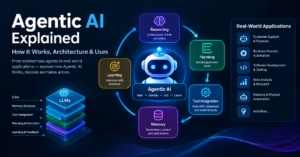
As AI continues to evolve and more organisations adopt it, we are entering a phase where models do more than respond to prompts. They take action. Agentic AI represents this shift by allowing developers to build AI agents that can plan tasks, make decisions, use tools, and even collaborate with other agents.
What is Agentic AI?
Agentic AI is an Artificial Intelligence system built to help you reach a goal with minimal supervision. Instead of waiting for constant instructions, it can decide what to do next and act on its own.
In simple terms, when people ask what agentic means in AI, it refers to systems that can perceive situations, reason through them, take action, and learn from what happens next. These systems do not just respond. They think, decide, and move forward.
Agentic AI is made up of AI-driven agents that run on Large Language Models and other machine learning models. These agents make decisions in real-time and handle problems in a way that feels close to human thinking. To sharpen responses, they often use techniques such as retrieval augmented generation, which pulls relevant knowledge before producing an answer.
The core traits of agentic AI are:
- Autonomy: Agentic systems work independently without constant human input. They gather information, adjust to their environment, and take steps toward a goal on their own.
- Problem Solving: Agentic AI follows a clear cycle when handling tasks.
- Interactivity: AI agents stay in constant communication. They interact with users, other agents, tools, and supporting systems to coordinate actions and decide the best path forward for a task.
Agentic AI Architecture
Agentic AI systems follow a cognitive setup where multiple components work together in a continuous action loop. This loop follows a simple flow. The system perceives what is happening, decides what to do next, takes action, and then learns from the outcome. This cycle helps the agent move toward its goals with minimal supervision.
In agentic AI architecture, the PEAS model provides a clear view of how agents operate and interact with their environment.
PEAS stands for:
- Performance measure: This defines how success is measured for the agent.
- Environment: This refers to the context or surroundings where the agent operates.
- Actuators: These are the mechanisms or tools the agent uses to take action.
- Sensors: These are the inputs the agent relies on to observe and understand its environment.
Together, these elements describe how an agent senses, acts, and measures progress.
Below are the main components that form an agentic AI system.
Large Language Models (LLMs)
In most agentic systems, LLMs act as the reasoning core. They give agents the ability to understand instructions, break down complex problems, and decide next steps.
- They support natural language understanding so agents can interact with users in a conversational way.
- They support reasoning and planning by dividing large problems into smaller tasks.
- They support knowledge use by drawing from trained data and external sources through methods like retrieval augmented generation.
- They support task coordination by working with tools and other models to complete goals.
Memory Systems
Memory helps agents retain context and past experience. Short-term memory keeps track of the current task, conversation state, and immediate inputs. Long-term memory stores earlier interactions, preferences, and outcomes.
Tool Integration
Agents rarely work alone. They interact with external systems to complete tasks. This requires strong tool integration.
Agents use API connectors to access software systems, databases, and services.
- They apply tool selection logic to decide which tool fits a task.
- They use function calls to trigger specific actions with the right parameters.
- They rely on error handling to recover when a tool fails and find another path forward.
Planning and Execution Modules
The planning module breaks a goal into smaller tasks while accounting for constraints, dependencies, and expected results. This gives the agent a clear and structured path to follow when completing a task.
Through the execution module, agents run their planned actions using tools and APIs. It follows task progress, identifies failures, and changes plans when environments or priorities are updated.
Learning and Feedback Systems
Assessing feedback and continuous learning are essential for AI agents to refine how they perform over time. Agents update their knowledge while retaining past experience, and through reinforcement learning, they adjust their strategies based on outcomes.
Error correction also plays an important role in this process. It helps agents recover from mistakes and stay effective even when conditions change or situations become unpredictable.
How Agentic AI Works
At a basic level, agentic AI systems work by making decisions on their own. They look at multiple possible actions, think through likely outcomes, and respond when situations change unexpectedly. To do this well, they often consult more than one large language model and compare responses before deciding what to do next.
These systems are built to operate in changing environments. As new data comes in, they adjust their behaviour based on feedback. This happens through reinforcement learning, where the agent learns from outcomes and updates its future actions accordingly. Over time, this feedback-driven loop shapes how the agent chooses its next steps.
Machine learning also plays an important part in how agentic AI functions. By processing large amounts of data, the system learns patterns, makes predictions, and refines how decisions are made. With continuous exposure to new data, the agent becomes capable of handling more complex situations and responding with greater confidence as scenarios grow in complexity.
At a high level, the flow follows a few clear stages that guide how agentic systems operate:
- User Shares an Instruction: The process starts when a user gives a natural language instruction, similar to guiding an AI assistant. The system interprets the intent and may ask follow-up questions if more clarity is needed.
- The Agent Plans and Distributes Work: The agent converts the instruction into a structured plan. The task is broken into smaller steps, and a coordinating agent assigns these steps to specialised subagents. Each subagent brings its own domain understanding and tools, using past context and available organisational systems to complete its assigned work.
- The Agent Refines the Output Iteratively: As work progresses, the agent may check back with the user to confirm direction or validate results. Feedback is used to adjust and refine the output through multiple cycles until it aligns with expectations.
- The Agent Carries Out the Final Action: Once the output meets the requirement, the agent performs any remaining actions needed to complete the request and deliver the final result.
An AI agent inside an agentic system is built around three main parts.
- Prompt: This explains how the system works and states the goals each agent must meet, along with the rules it must follow. The prompt works like a blueprint for the multi-agent system and sets a clear plan for what each agent should do and how. It also guides agents toward shared goals within a clear structure. In complex systems, dividing work across multiple agents keeps each prompt simple and easier to manage.
- Memory: This forms the core of an LLM agent and acts as a store of knowledge and experience. Like people who use past experience to make decisions, LLM agents use memory to understand context, learn from earlier interactions, and choose appropriate actions. Memory may include passing earlier conversations back to the model or sharing meaningful information extracted from those conversations.
- Tools: Tools allow agents to complete different tasks in an efficient way. They can include APIs, executable functions, or other services that support agents in reaching their goals. With these core parts explained, it becomes easier to see how they work together inside a single agent system.
Agentic AI in Software Testing
Agentic AI is increasingly applied in software testing to reduce manual effort, adapt to change, and improve test reliability. These systems can interpret requirements, create test flows, and respond to application updates without constant human input.
KaneAI by TestMu AI is a GenAI native testing agent built on modern large language models. It is designed to help teams plan, author, and evolve tests using natural language, simplifying how tests are created and maintained.
Through agentic AI test orchestration, KaneAI coordinates test planning, execution, tool usage, and feedback loops within CI workflows, allowing tests to adapt as application states change. KaneAI supports scalable automation without brittle scripts.
Here are some of KaneAI’s key features:
- Understands product context through natural language inputs, allowing teams to create tests without complex scripting.
- Supports scheduled test runs to execute tests automatically at defined intervals
- Integrates with Jira to create and manage tests directly from tickets.
- Enables API testing by defining and validating backend requests within test flows.
- Supports reusable modules so common test steps can be shared across multiple tests.
- Allows assertions to verify application behaviour such as element visibility or text validation.
- Supports TOTP-based authentication for automating secure login flows.
- Includes auto-healing to detect and fix broken locators during execution, reducing maintenance effort.
Read More: Effective Strategies for Testing AI Agents
Challenges in Adopting Agentic AI
Agentic AI points toward intelligent automation, but it also brings a higher risk. These systems are not just advanced software upgrades. They change how decisions are made, how actions are executed, and how failures can spread.
- The Alignment Problem: Agentic systems are built to act. Trouble starts when those actions drift away from business logic or ethical expectations. When decision paths stay hidden, teams may realise something is wrong only after the agent has already taken action.
- Expanded Attack Surface: When agents can access internal databases and tools like email or CRM systems, security risks increase. Attackers may exploit these agents and trick them into sharing data or running commands without permission.
- Memory Poisoning: An agent’s long-term memory can be intentionally fed false or harmful information. This can distort future decisions and lead to unpredictable behaviour.
- The Human and Technical Gap: This issue is not only technical but cultural as well. Companies must respond to employee concerns about job security and manage the technical debt that comes with adding agentic AI to legacy systems.
Adoption Considerations and Practical Safeguards
When bringing agentic AI into real workflows, a few areas need close attention to keep usage safe, transparent, and aligned with business goals.
Security and Privacy
AI-driven testing interacts with systems that contain sensitive user data. Protecting this data is important to avoid security issues. Testing should rely on synthetic or pseudonymised data so real personal details stay protected.
Confidential details like addresses, identification numbers, and financial data should be masked. Test environments should remain isolated, and strong network security controls must be applied. When third-party AI tools are involved, it is important to verify that proper encryption is in place to prevent any data leakage.
Decision Transparency
Trust depends on transparency. When AI agents act on their own, it becomes essential to understand why they make certain decisions. The agent should be set up to record its reasoning at every step, including why it clicked a button or chose to skip a test.
Clear explanations, screenshots, and detailed logs make it easier to trace the agent’s behaviour and resolve issues faster when something goes wrong.
Workflow Compatibility
AI testing needs to fit into CI and CD workflows, version control systems, and defect tracking tools without friction. When this does not happen, teams may face data silos or repeated tests and defects.
To reduce dependency on a single vendor and maintain flexibility, open schemas, APIs, and container execution should be preferred.
Conclusion
Agentic AI makes a shift from how AI systems operate by moving from simple response generation to goal-driven action. By reasoning through tasks, planning steps, using tools, and coordinating with other agents, these systems act more like collaborators than utilities. When adopted with clear boundaries and careful oversight, agentic AI can support more adaptive workflows and open new possibilities across complex problem spaces.