
An artificial intelligence agent is a software program that can interact with its surroundings, gather information, and use that information to carry out tasks on its own based on set goals. Humans decide the goals, but the AI agent selects the actions it needs to take to reach those goals without direct human control.
As more products and services depend on AI agents, testing them becomes essential. Traditional software testing methods are not enough because AI agents do not follow fixed rules or produce the same output every time. This article explains effective strategies for testing AI agents in real conditions.
Effective Strategies For Testing AI Agents
The following strategies outline practical approaches to testing AI agents.
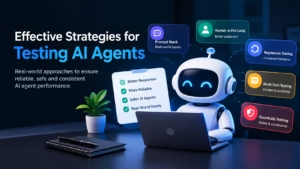
Build a Prompt Bank That Mirrors Real Usage
A well-planned prompt bank helps you evaluate how an AI agent responds to real inputs from users. Instead of checking only perfect questions, the prompt bank should involve many types of queries that show how people actually communicate. This approach supports improving how the system reacts in the real world and how it evolves with time.
The prompt bank should include common questions, regular use cases, informal language, spelling mistakes, unclear instructions, tricky prompts, domain terms, and region-based or cultural language patterns. These inputs help analyze different behaviors and improve reliability. When you regularly update and organize the prompt bank, testing becomes easier and checks become clearer. This process supports better responses that feel more natural to users.
Use Human in the Loop Testing
Automation can catch clear mistakes and performance changes, but human reviewers are better at judging tone, context, and meaning. Human-in-the-loop testing adds depth to the review process and helps find issues that automated checks often miss. This method supports improving quality and keeps the system aligned with real user needs.
Feedback should follow a clear structure. They can tag outputs with labels such as too vague, hallucinated fact, or excellent answer to support better understanding. Written comments should be collected for unclear or subjective cases, which helps with deeper review and learning.
This testing approach is widely used during beta stages and after release. It plays a key role in improving results, enhancing reliability and overall system behavior in today’s fast-paced digital world.
Automate Regression Testing for Consistent Behavior
AI agents can change their behaviour over time, especially when models are updated, fine-tuned, or adjusted for new use cases. Automated regression testing verifies that crucial behaviours continue to work as expected after these changes. It checks whether responses remain consistent across versions and helps surface unexpected shifts before they reach production.
As testing needs grow, running regression checks manually or on local systems becomes harder to manage. Cloud-based testing platforms are often used to handle this at scale. TestMu AI is one of the AI agent testing tools that supports this approach by helping teams run smart regression workflows, track behaviour changes across updates, and identify issues early, without the overhead of setting up or maintaining in-house testing infrastructure.
Test Multi-Turn and Contextual Interactions
AI agents work through conversations and adjust responses based on earlier inputs. They do not respond to single messages in isolation. Testing multi-turn interactions is important to understand how the agent behaves in real situations where context matters.
Testing should check whether the agent can hold context across three or more turns. It should handle interruptions or user corrections without losing track of the discussion. The agent should summarise earlier messages when asked and follow different paths when the conversation branches. It should also avoid repeating the same information or giving responses that conflict with earlier replies.
Scripts or recorded conversation flows that reflect real user journeys should be used for this testing. This approach helps validate how well the agent manages context and maintains clear and consistent dialogue.
Evaluate Safety Through Guardrails Testing
As AI systems grow in capability, safety checks become a required part of testing. Guardrails testing checks how an agent reacts when it receives inputs that may cause harm or break rules. This type of testing looks at safety, compliance, and ethical behaviour in real situations.
Testing should include cases with toxic or offensive language, attempts to bypass rules, sensitive subjects, bias-related triggers, and requests that break platform rules or internal policies. These inputs show how the agent responds under pressure and during risky situations.
The expected behaviour should remain clear and calm. The agent should refuse politely when it cannot respond. It should redirect users to human support when needed. It should return safe fallback messages and follow clear paths for errors or escalation.
This testing builds confidence in the system and lowers the chance of risk during real use.
Measure Performance Using Multi-Dimensional Metrics
Relying on a single metric, such as accuracy does not give a full picture of how an AI agent performs. A stronger testing approach looks at multiple signals that cover both technical behaviour and user experience. This helps teams understand not just whether the response was correct, but whether it was useful and appropriate.
Performance should be reviewed across a combination of measures. Task completion rate shows whether the user goal was achieved. Usefulness checks whether the response matched the user intent. Clarity looks at how easy the response was to understand. Latency measures how quickly the response was delivered. Toxicity and bias scores help review whether outputs follow ethical and safety standards.
Looking at these measures together provides a balanced view of how the AI agent performs in production. It also makes it easier to identify specific areas where improvements or adjustments are needed.
Why AI Agents Require a Different Testing Approach?
The following are the key reasons AI agents require a different testing approach.
Unpredictability and Non-Determinism of AI Outputs
Traditional software follows fixed rules. When it receives the same input, it gives the same output every time. AI agents behave differently. Their responses can change based on small wording changes, earlier conversation context, or updates to the model.
A lack of consistency adds difficulty to the testing process. Deciding what counts as one correct answer becomes unclear. Responses may differ in wording and still be acceptable. Testing must recognise more than one valid output. It should check whether the meaning is accurate and whether the response stays aligned with user intent across variations.
Interaction-Based Behaviour Compared to Static Input-Output
AI agents do more than respond to one command at a time. They take part in ongoing conversations that depend on context and past messages. Their usefulness depends on how well they understand user intent across many turns and how accurately they retain context during the interaction.
Because of this, static test cases are not enough. Testers must build real conversation flows and observe how the AI responds as the discussion changes. Each response should add value to the conversation and remain aligned with user intent.
This interaction-driven behaviour calls for testing methods that reflect real usage patterns rather than traditional question and answer checks.
Ethical Safety and Performance Concerns
AI agents used in areas such as healthcare, finance, and legal services cannot be evaluated on accuracy alone. Their behaviour needs to be examined through ethical, safety, and performance lenses. Ethical reviews help uncover bias and unfair responses. Safety checks focus on identifying harmful or misleading outputs. Tone checks assess whether the agent communicates in a responsible and respectful manner.
Performance also needs attention during difficult situations. The agent should be tested with unusual questions, heavy usage and high-risk scenarios. These tests show how the system reacts under pressure and whether it stays stable and dependable.
These layers of testing protect organisations from trust issues, legal problems, and brand damage. They form an important part of AI development work and cannot be skipped.
Differences From Conventional QA Processes
In conventional software testing, requirements are clearly defined and behaviour follows fixed rules. This makes validation simple because the same input produces the same result. AI agents work differently. They rely on probabilistic models and learned patterns rather than hard-coded logic. Their behaviour comes from training data, not from fixed rules written by developers.
For this reason, traditional unit tests or rule-based scripts are not enough. Testing AI requires different methods such as varying prompts, scoring outputs, running realistic scenarios, and reviewing responses manually. These methods account for unpredictable behaviour and varied outputs. Testers also need to watch for model drift, ongoing learning changes, and shifts in how users interact with the system over time.
Mistakes to Avoid When Testing Your AI Agent
Here are some mistakes one should avoid while testing AI agents.
- Over-Reliance on Accuracy Metrics: Accuracy alone can give a misleading picture of AI behaviour. Scores such as precision, recall or similar metrics show numerical performance but do not reflect real interaction quality. An agent may score high and still struggle with context understanding, tone control or user-specific intent. Quantitative checks without human review can create false confidence and hide real issues.
- Ignoring Edge Cases or Out-Of-Domain Prompts: Testing only expected or clean queries does not reflect real user behaviour. Users often ask unclear questions, use slang, make spelling mistakes, or raise unexpected topics. If these situations are not tested, the system can fail after release. Edge cases, cultural variations, and adversarial prompts are part of real usage, and skipping them leads to systems that perform well in tests but struggle in real conditions.
- No Real-World Simulation or User Feedback Loop: Testing AI agent without real usage scenarios limits learning and growth. Controlled tests do not reflect how users actually interact with the system. Real user interactions reveal where responses work well and where they fail. Without continuous feedback and iteration, the agent can stop adapting to user needs. Testing should include methods such as A/B testing, shadow deployments, and feedback-based tuning so behaviour matches real interaction patterns.
- Treating Agents As Static Models Instead of Adaptive Systems: AI agents are not fixed systems that stay the same after release. They change as models are updated, data shifts and user behaviour changes. Treating them as one-time deployments ignores this adaptive nature. If testing does not account for model updates, data drift or prompt behaviour changes, test results lose value quickly. Ongoing testing, monitoring, and validation are required to keep behaviour consistent and aligned with user expectations over time.
Conclusion
Testing AI agents is not a one time task. It is an ongoing process that must grow along with the system. Because these agents respond based on context, language, and learned patterns, their behaviour can change over time and across situations. This makes careful testing necessary at every stage.
A strong testing approach combines real usage prompts, human review, automated checks, multi-turn conversation testing, safety validation, and performance measurement. Each method adds a different layer of insight, and together they show how the agent behaves in real conditions. Teams also need to stay alert to common mistakes, such as trusting only accuracy scores or skipping real user feedback.