
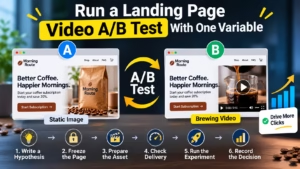
The coffee-bag photograph is still on Morning Route’s landing page after two weeks of debate. In this fictional example, Marco’s coffee subscription team is weighing a 15-second brewing video. One side wants to show the brew; the other worries the page will slow down. Nobody has tested it.
A landing page video A/B test turns that argument into a measurable question: keep the current image as A, use one video as B, and compare the same button-click behavior. Marco’s plan runs in six steps: write the hypothesis, freeze the page, prepare the asset, check delivery, run the experiment, and record the decision.
Write a Measurable Landing Page Video A/B Test Hypothesis
Write down the change and the visitor action before producing anything. Morning Route’s question is whether replacing the coffee-bag image with a brewing video changes the share of exposed visitors who click “Start Subscription.”
The creative idea, that brewing footage makes the coffee feel more tangible, is a possible mechanism, not the thing being measured. A click records an action; it doesn’t prove understanding, and completed subscriptions sit further down the journey. Button click-through rate is the sole success metric.
The working hypothesis: “Among eligible visitors, replacing the coffee-bag image with the selected brewing video will increase the proportion clicking Start Subscription.” Test the increase without predicting its size, and confirm the button fires the same event in both versions.
Keep the Rest of the Hero Page Unchanged
The hero is the page’s prominent opening section. Both versions keep the same headline, offer, button, and layout; only the media in that space changes.
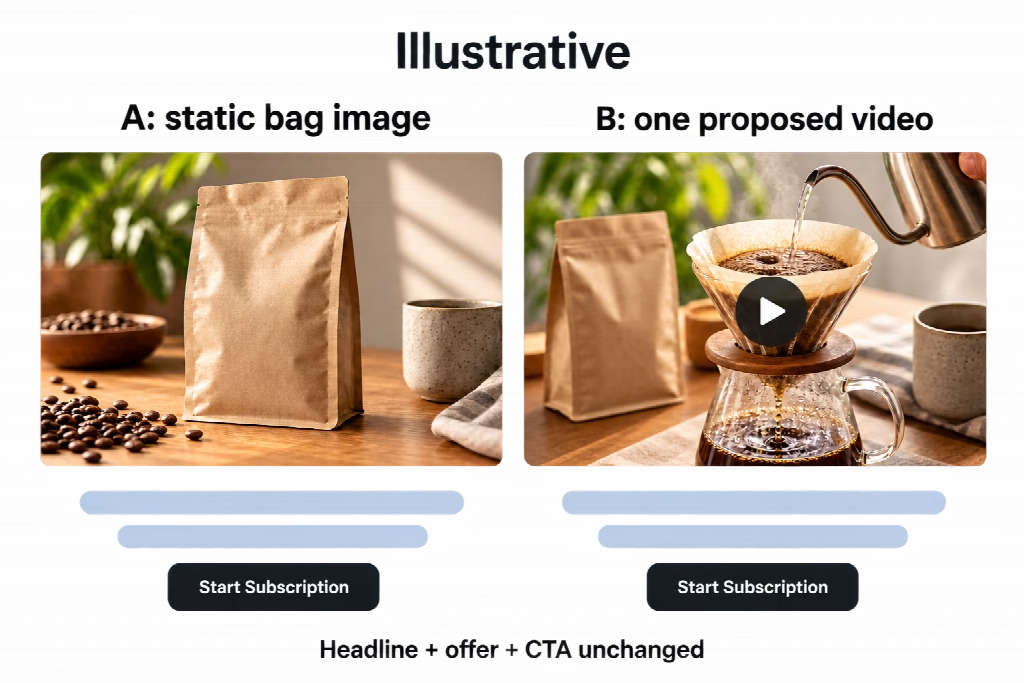
Illustrative planned A/B treatment: only the hero media changes from the coffee-bag still to one proposed brewing video; headline, offer, CTA, and layout stay the same. No test result is shown.
| Element | A: current page | B: proposed page |
| Hero media | Static coffee-bag image | One approved brewing video treatment |
| Headline and offer | Current approved wording | Same wording |
| Start Subscription button | Current copy, position, and destination | Same copy, position, and destination |
| Remaining content | Current page | Same page |
| Assignment and events | Defined experiment rules | Same rules and event meaning |
Keep the product information comparable as well. A discount or a new quality claim inside the video would add a second persuasive change.
Let the experiment system assign visitors randomly and keep each visitor’s assignment stable. Record exposure the same way for both groups: when the assigned page loads, before any video plays. Include B visitors whose video never starts, because counting only successful plays would select a different audience and hide delivery failures. If someone changes a headline or campaign mid-test, log it and check whether the comparison still holds.
Produce Video Candidates From One Brief
AnAI video agent is one production option: its feature page describes turning a brief and reference material into a creative plan, scenes, visual direction, and revisions. Editing authorized footage manually works too.
Start with one approved brief: the coffee-bag reference, brewing footage, intended message, and current offer, with rights checked for every asset. The team might draft two or three 15-second cuts, one opening on the bag and another on the brewing action, without adding an invented origin story, customer experience, or promotion.
Pick one cut for B in an internal review and reject anything that misrepresents the product. Several drafts still lead to only two live versions; testing multiple videos at once is a different experiment, so save questions about openings for later. Record the exact file, poster, and playback behavior, and confirm the deployed file matches the approved cut.
Protect Page Speed in the Video Treatment
An editing preview says little about what visitors see while the page downloads. Compare the real A and B pages on the devices and connections your audience uses.
Give the video a clear, lightweight poster image, and fix the playback choice (click-to-play or autoplay) before launch. A click-to-play player can defer heavy loading, but the poster must still appear promptly; if it’s the largest visible element, delaying it delays the hero. So don’t lazy-load everything blindly: check the poster, video, and any third-party player requests separately.
Then check the experience. Can visitors see the product, read the headline, and tap Start Subscription quickly, especially on mobile? Watch for a blank cover, controls overlapping the button, or layout shifts that push it down. Set these performance and usability conditions before reviewing clicks. If B fails them, fix it and restart; a broken version says nothing about brewing footage.
Run the Experiment to Its Planned Endpoint
Before launch, agree on the sample plan and decision rule with whoever owns experimentation. Base it on the page’s own click baseline and traffic, plus the smallest change that would matter to the business, not on visitor counts borrowed from another site. If traffic is too thin for the question, reconsider the test before producing more assets.
Pick the analysis method in advance, whether a fixed endpoint or a sequential design with its own rules, and don’t switch after seeing a favorable number. Keep a dated log of campaign changes, outages, or replaced assets.
For each group, divide exposed visitors who clicked Start Subscription at least once by all exposed visitors. Monitor for operational problems, but a temporary dashboard lead is not a stopping rule. At the planned assessment, review the difference and its uncertainty: evidence may favor A, favor B, or stay inconclusive. Video plays and watch time can explain delivery but stay out of the decision.
Record the Decision and the Next Test
Save the experiment as a decision record, even if the outcome is inconclusive. Marco could draft this before launch; it contains a plan, not results:
| Record field | Morning Route entry |
| Question | Does the selected brewing video change Start Subscription click-through versus the coffee-bag still? |
| Treatment files | A: approved still; B: the approved cut and poster, filenames attached |
| Exposure | Assigned page load, same trigger in both groups; non-playing B visits included |
| Success | Exposed visitors clicking Start Subscription at least once |
| Launch gate | Owner attaches the traffic plan, analysis rule, endpoint, and page checks |
| Result and decision | Open until the planned assessment |
If the rule supports B and the guardrails hold, adopt the video for this page. If A is favored or the result is inconclusive, keeping the image is a defensible choice. Separate uncertainty from failure: missing events or a broken player need a repaired test, while a valid but uncertain result needs an honest record.
Even a clear click improvement leaves subscriptions and revenue unmeasured, so keep the conclusion tied to this page, audience, and period. For your own landing page testing, pick the element causing the longest argument and write one hypothesis naming the visitor behavior that would settle it.