

Farragut isn’t a “TDS-or-nothing” town anymore. Nine wired or wireless ISPs now chase your business: TDS fiber and Spectrum cable reach about 99.8 percent of suites, LCUB’s municipal fiber is already live on select blocks, and WOW!, AT&T, Comcast, and others add strong options. Before you compare prices, drop your exact suite number into each provider’s availability tool—the answer can flip from “orderable today” to “construction required” in a single block. This guide shows which plans install fastest, what they really cost after promos expire, and the smartest ways to bolt on a fail-safe backup line.
Quick answer: best provider for each business scenario
Need the TL;DR? Start here, then confirm service for your exact suite.
Most offices can land fast, symmetrical gigabit for $49.99–$89.99 a month with TDS. Inside LCUB’s electric footprint, the utility’s 500 Mbps, 1 Gbps, and 2.5 Gbps plans (from $89.95) often win on long-term value and local support. If you require multi-gig speeds or a written 100 percent-uptime SLA, request AT&T Business Fiber or AT&T Dedicated Internet quotes. When fiber construction would delay move-in, Spectrum or Comcast coax lights up existing lines in days. For backup, pair your primary wireline with another failure domain: a Verizon or T-Mobile 5G gateway installs in about an hour, while Starlink adds a roof-mounted satellite path immune to local pole cuts.
| Business need | First quote to pull |
| Broad, symmetrical fiber today | TDS |
| Local-value fiber where available | LCUB |
| Multi-gig or enterprise-grade SLA | AT&T |
| Quick install on existing cable lines | WOW!, Spectrum, or Comcast |
| Rapid wireless backup | Verizon 5G or T-Mobile |
| Path-diverse satellite backup | Starlink |
These picks can change within a single block. Always run each provider’s address checker before locking in a price—the latest FCC file shows TDS fiber and Spectrum cable at roughly 99.8 percent coverage, but that stray 0.2 percent still strands real offices. In the next sections, we unpack the contract fine print and show how to layer true redundancy.
How we evaluated providers
Address serviceability comes first
A tempting headline means nothing if the crew can’t pull fiber to your rack. We open every comparison with one binary question: Can the provider install service at your exact suite for its standard installation charge? FCC availability files give us a directional map; TDS fiber and Spectrum cable touch about 99.8 percent of Farragut business addresses, while LCUB, AT&T, and Comcast show far smaller footprints, but the decisive answer always comes from each ISP’s address checker and a dated quote. We place providers into four buckets:
- Orderable now – typical lead time, no special construction.
- Near-net / build-to-order – close enough to build, but expect a survey or construction cost.
- Backup-only – wireless or satellite suitable as a secondary path, not a primary.
- Not currently serviceable – no realistic route without major build expense.
Only the first three classes appear in our core list, so you never negotiate “fantasy bandwidth.”
Farragut business internet price and speed snapshot
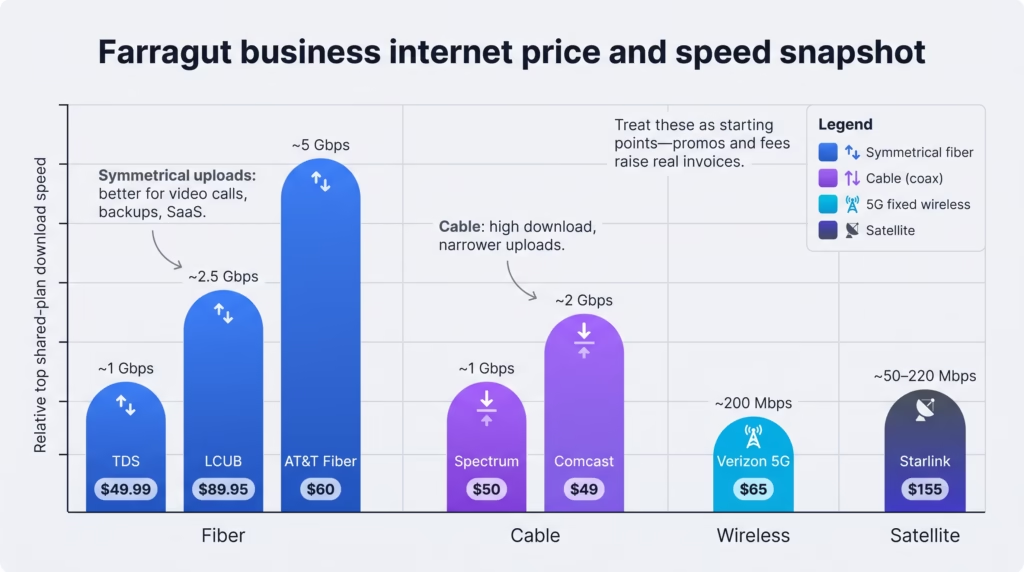
Treat the figures below as starting points. Promotions, equipment fees, taxes, and construction contributions can add 20–40 percent to the first number you see. Always request an all-in, post-promo quote before choosing.
| Provider | Shared-plan top speed | Lowest published price | Price type | Contract notes |
| TDS | 1 Gbps symmetric | $49.99 | 12-mo promo | No contract on promo; term cuts hardware costs |
| LCUB | 2.5 Gbps symmetric | $89.95 | standing rate | Labels list no contract or install fee; verify in writing |
| AT&T Business Fiber | 5 Gbps symmetric | $60 (300 Mbps tier) | month-to-month | 1 Gbps+ tiers include 5G backup; no annual contract |
| Spectrum Business | 1 Gbps / 35–40 Mbps up | $50 (year 1, 500 Mbps) | 12-mo promo | No contract; renewal jump starts month 13 |
| Comcast Business | 2 Gbps / 100 Mbps up | $49 (300 Mbps tier) | 12-mo promo | Five-year price lock requires a one-year term |
| Verizon 5G Business | ~200 Mbps typical | $65 | standing rate | Month-to-month; ten-year price guarantee |
| Starlink Local Priority | 50–220 Mbps down | $155 (500 GB) | standing rate | Month-to-month; hardware extra |
Two quick patterns matter:
- Symmetrical uploads are still the dividing line. TDS, LCUB, and AT&T give you equal up-and-down speeds, which is critical for video calls, cloud backups, and SaaS stacks. Cable tiers from Spectrum and Comcast advertise high downloads, but uploads stay narrow.
- Advertised rates are not the invoice. Static-IP blocks, Wi-Fi extenders, and construction surcharges can pad the bill fast. Get every recurring and one-time charge, including month-13 pricing, in writing before you decide.
Use the table to build a shortlist, then keep reading for contract fine print and true redundancy strategies.
1) WOW! Business: best regional alternative to quote early
WOW! Business is the regional carrier worth quoting first. Its Knoxville, TN business internet services page names Farragut among the communities it serves, alongside Downtown Knoxville, Bearden, Cedar Bluff, West Knoxville, and Powell, and lists Farragut ZIP codes 37922 and 37934.
Three tiers cover most offices: 300 Mbps for light use (up to 5 connected devices, HD video calls, and cloud file sharing), 600 Mbps for heavier use (up to 10 devices, guest networks, security systems, and web servers), and 1.2 Gig for the busiest sites (up to 15 devices). On a one-year term, 600 Mbps starts at $65.99 a month, and doubling to 1.2 Gig costs just $5 a month more. For upload-heavy work, WOW! offers symmetrical speeds of up to 5 Gig.
What comes with the service:
- Free installation and a free modem for the first three months on 300 Mbps and above.
- Whole-Business WiFi starting with two eero devices for mesh coverage across the office, with more units available.
- Built-in security on every plan, including network safety blocking of malicious domains and URLs.
- Price-Lock Guarantee: your rate does not rise during the contract period.
- 99% network reliability and 24/7/365 U.S.-based support.
- A $10 monthly discount when you bundle phone service, and a 60-day satisfaction guarantee.
That mix makes WOW! a strong primary line for Farragut offices that want predictable billing and fast setup, and a natural partner for a 5G or satellite backup.
2) TDS Business Fiber: best current fiber reach
Why TDS often wins the first quote
TDS fiber touches roughly 99.8 percent of Farragut business addresses, so the odds of a “yes, installable” response on day one are high. The Knoxville-area order form lists symmetrical 500 Mbps for $49.99, 600 Mbps for $64.99, and 1 Gig for $89.99, all month-to-month with free basic installation and a 60-day satisfaction guarantee, according to the TDS Business Fiber order form.
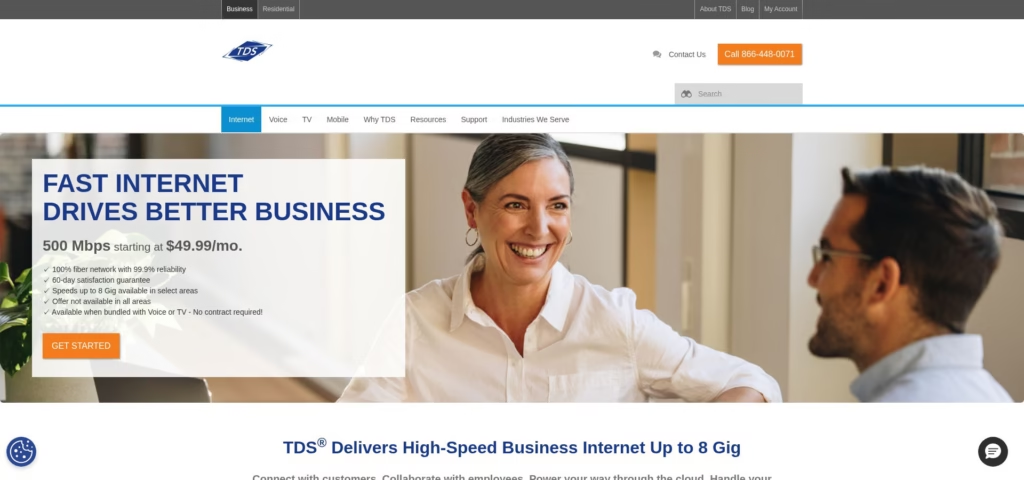
TDS Business Fiber Knoxville product page showing symmetrical gigabit plans.
That blend of blanket coverage, equal upload speeds, and a sub-$90 gigabit option makes TDS the low-friction pick for most offices. You can run Teams calls, off-site backups, and cloud POS without waiting on construction.
Bottom line: if you need fast, symmetrical fiber that’s already in the street, start with a TDS quote. In the next section, we break down reliability language and when to step up to TDS Dedicated Fiber with its 99.99 percent SLA.
3) LCUB business fiber: best transparent local fiber where live
LCUB is Farragut’s hometown wildcard. When its fiber reaches your meter, you get plain-English municipal pricing: 500 Mbps for $89.95, 1 Gbps for $149.95, and 2.5 Gbps by quote. All are labeled as non-introductory with zero installation fee and an optional static-IP block for $10.
Support is just down the street. The service center on North Campbell Station Road fields calls with the same technicians who drive LCUB bucket trucks, so dispatch times stay local.
Roll-out remains the catch. LCUB reported 37,676 locations passed as of April 1 2026 and projects another 18–24 months to finish its electric territory. One block can order today while the next still waits for splicing.
Read the paperwork carefully. The public broadband label says “no contract,” yet the business agreement still includes renewal and termination clauses, plus a line restricting use to “personal, residential, noncommercial” traffic. Flag those inconsistencies and have the rep initial any corrections.
If LCUB already serves your address, request a quote. You’ll lock in symmetrical multi-gig speeds, predictable rates, and a genuinely local support desk. If construction is one pole away, treat LCUB as your long-term primary and keep a month-to-month cable or 5G line until the splice crew arrives.
4) AT&T Business: best multi-gig and enterprise SLA where serviceable
AT&T steps in when you need more than a single gig, or a contract that literally pays you if it goes dark. Shared Business Fiber runs 300 Mbps for $60, 500 Mbps for $100, 1 Gbps for $140, 2 Gbps for $185, and 5 Gbps for $285 month-to-month; 1 Gbps and higher include an automatic 5G failover modem at no extra charge.
Upgrade to AT&T Dedicated Internet, and the promise tightens: 10 Mbps to 1 Tbps of reserved bandwidth, proactive monitoring, and a 100 percent uptime guarantee backed by service credits (credits escalate with outage length). Options include BGP, DDoS scrubbing, and managed SD-WAN through the same order form.
The catch is dirt. Incorporated Farragut shows only slivers of AT&T fiber today, even though the streets just north and west light up multi-gig signals. Many addresses require a survey and possible construction share, especially for DIA. Expect added weeks if the nearest splice vault is not a straight pull.
Before you sign:
- Run the checker for both shared Fiber and DIA; footprints differ.
- Request line-item pricing for construction, equipment, and 5G-backup hardware.
- Verify whether any promotional reward card lowers monthly spend or simply buys printer toner.
Clear those hurdles and AT&T becomes the heavy-lift option: multi-gig bandwidth today, an enterprise-grade SLA tomorrow, and room to scale long after your cloud bill crosses six figures.
5) Spectrum Business: best broad cable footprint
Spectrum’s hybrid-fiber-coax grid already passes roughly 99.8 percent of Farragut business addresses, so most suites can light up service in days, not weeks. The current Knoxville offer page lists 500 Mbps download for $49.99, 750 Mbps for $94.99, and 1 Gbps for $114.99, all contract-free for the first 12 months and free of data caps. Upload lanes still trail fiber, about 35–40 Mbps on the 1 Gbps tier, although mid-split upgrades have started to raise upstream capacity in some markets.
Need guaranteed uptime? Spectrum Enterprise quotes Dedicated Fiber Internet with symmetrical 1 Gbps to 100 Gbps circuits, a 100 percent availability SLA, and six-hour mean-time-to-restore, often re-using conduit already in the right-of-way.
Watch the fine print:
- Month 13 brings a rate increase unless you renegotiate.
- Static-IP blocks, Wi-Fi extenders, and voice lines add recurring dollars, so get each fee in writing.
Bottom line: Spectrum is the fastest low-friction way to get meaningful bandwidth live this week, and its enterprise arm can scale to carrier-grade SLAs when your workload demands it. Just budget for the post-promo climb and confirm your real upload lane.
6) Comcast Business: best limited-footprint wired alternative
Comcast’s coax plant touches about 12 percent of Farragut business addresses, but where it’s lit you gain a second mainstream carrier physically separate from Spectrum, lowering the odds that one pole strike silences both links.
Current Knoxville pricing shows 300 Mbps for $49, 500 Mbps for $69, 1.25 Gbps for $99, and 2 Gbps for $149 on a 12-month promotion, with no data caps. Uploads trail fiber yet reach up to 100 Mbps on the 2 Gbps tier, enough for overnight cloud backups.
Need an SLA? Comcast’s Dedicated Internet delivers symmetrical 10 Mbps–10 Gbps over HFC or fiber, backed by a 99.99 percent uptime commitment and proactive monitoring. Suites already sitting on an HFC node often install in about 30 days without a civil-works bill.
Watch two wrinkles:
- The “five-year price lock” requires at least a one-year term; cancel early and you’ll owe an ETF.
- Billing disputes over promo expirations are common. Insist on a signed service-order summary listing every recurring and one-time charge, then set a calendar alert 50 days before the anniversary.
If your building qualifies, quote Comcast even when another provider looks solid. A route-diverse second path plus a written SLA can turn an outage from lost revenue into a brief Teams notification.
7) Verizon 5G Business: best rapid-deployment backup
When you can’t wait for a fiber crew, Verizon’s 5G Business Internet can ship a self-install gateway in two days, and most offices move from “offline” to live traffic in under an hour. The Knoxville offer lists 100 Mbps for $65, 200 Mbps for $85, and address-qualified 400 Mbps for $110, all month-to-month with a 10-year price guarantee; a qualifying mobile line drops those rates by $30.
Where it shines:
- Construction gap: brand-new suites keep payroll, point-of-sale, and Wi-Fi online while sidewalks are still open.
- Automatic failover: pair the 5G modem with a dual-WAN firewall so card readers glide through the next pole strike.
- Pop-up sites: trailers, festivals, or election offices power up broadband anywhere there’s an outlet, and LTE backup batteries cover brief power dips.
Caveats: Low-E glass and heavy lunch-hour tower load can throttle speeds. Test the router in its final rack position, and budget an external antenna if the signal light stays yellow.
As a backstop, Verizon gives you what wired carriers can’t: business-class bandwidth live this afternoon with no construction invoices.
8) T-Mobile for Business: best flexible wireless alternative
Plug the gateway into a wall outlet, scan a QR code, and you’re online in minutes, with no trench, permit, or contract. The Small Business Grow plan runs $50 per month, or $35 when bundled with a voice line, both locked by a five-year price guarantee and a one-time $35 device fee.
Typical performance lands around 100–300 Mbps down and 20–40 Mbps up. Users who exceed 1.2 TB a month are deprioritized during congestion. That’s plenty for email, VoIP, and point-of-sale traffic, though you’ll want to schedule big backups after hours.
A $10 monthly static IP add-on unlocks VPNs, hosted PBX trunks, and remote-camera feeds. Pair the modem with a dual-WAN router, and failover testing becomes a Sunday-morning chore instead of a three-week ticket.
Need higher uptime? SuperBroadband bundles T-Mobile 5G with Starlink and advertises 99.99 percent availability. It’s quote-only but solves the “two carriers, same pole line” flaw that haunts terrestrial backups.
Caveats: basement offices and valley floors can muffle radio waves. Test the gateway in its final rack spot, and budget a roof antenna if the LED never climbs past yellow.
When the signal is green, T-Mobile offers a rare mix of low cost, rapid deployment, and public IPs, letting you roll a credible disaster-recovery link into a backpack.
9) Starlink Business: best path-diverse satellite backup
One back-hoe can silence every terrestrial carrier on Kingston Pike, but a dish that talks to space dodges that risk. Starlink Business Local Priority costs $155 a month for 500 GB of priority data and includes a 99.9 percent network-availability SLA with a 20 percent bill credit when the threshold is missed. Speeds typically land between 50–220 Mbps down, 10–30 Mbps up, and about 30–60 ms latency, plenty for VoIP, VPN log-ins, and cloud dashboards. After the 500 GB bucket empties, service continues at lower priority, or you can add 50 GB or 500 GB blocks at published rates. Hardware runs about $2,500 and ships in two to three weeks.
Deployment is equal parts ladder and line-of-sight math. Mount the dish with a clear southern sky view, bolt a small UPS to keep the modem alive during power blips, and point your dual-WAN firewall to treat Starlink as the “B” circuit. Test failover quarterly.
Two realities:
- Roof access matters, and tenants may need landlord sign-off.
- Heavy rain or snow can dent throughput, so keep a 4G or 5G modem as tertiary failover if you need “three nines” or better.
Used as intended—a last-ditch link unaffected by local splice cases—Starlink turns a potential day-long outage into a quick WAN-failover alert.
10) IRIS Networks: best custom Tennessee enterprise carrier
When a national ISP won’t redraw a route map for one county, IRIS Networks often will. Headquartered in Nashville and focused on Tennessee businesses, IRIS designs custom dedicated-fiber circuits up to 100 Gbps, served over its own regional backbone. Local account teams can pull trench maps, not canned call-center scripts, and assign a project manager who knows every splice case between Farragut and Knox Central.
Everything is quote-only: speed, term, construction contribution, and even SLA percentage, yet that blank page is the selling point. Need two diverse entrances to a medical office plus BGP failover to an Atlanta data center? IRIS will price it and build it, with 24/7 Knoxville-staffed NOC support and optional DDoS mitigation baked in.
Expect longer lead times and higher per-megabit pricing than shared broadband; custom trench work rarely finishes in under 60 to 90 days. Still, if an auditor demands iron-clad route diversity, or your SaaS stack crawls when packets detour through Chicago, IRIS is the number you keep handy.
For most SMBs, file the card for future growth. For hospital groups, logistics hubs, and SaaS developers, start the engineering walk-through now so the glass is live before the next capacity crunch.
TDS vs. AT&T vs. LCUB: which provider deserves your primary line?
All three deliver symmetrical fiber, but they differ on availability, speed ceiling, and contract muscle.
- TDS covers about 99.8 percent of Farragut business addresses and installs 500 Mbps–1 Gbps plans for $49.99–$89.99 month-to-month, making it the fastest way to land reliable gig-class service this month.
- AT&T is the multi-gig and SLA leader: 300 Mbps–5 Gbps Business Fiber ($60–$285) or Dedicated Internet up to 1 Tbps with a 100 percent uptime guarantee. Availability is address-specific and may require construction time and a cost share.
- LCUB wins on transparent, non-introductory pricing, $89.95 for 500 Mbps, $149.95 for 1 Gbps, and hyper-local support, but rollout is still underway, so check your exact meter number first.
Quick rule of thumb:
- Need fiber this month? Order TDS.
- Need multi-gig or a contractual SLA? Request an AT&T quote and budget build time.
- Want hometown rates and local technicians? Refresh LCUB’s checker until your address turns green.
Still undecided? Ask every rep:
- What install date can you commit to in writing?
- Do I receive a formal SLA or only “network reliability” language?
- What is my invoice after any promotion expires?
Their answers reveal the right choice and the real total cost.
Shared business fiber vs. dedicated internet access: know what you’re buying
Both arrive on glass, but that’s where the similarity ends.
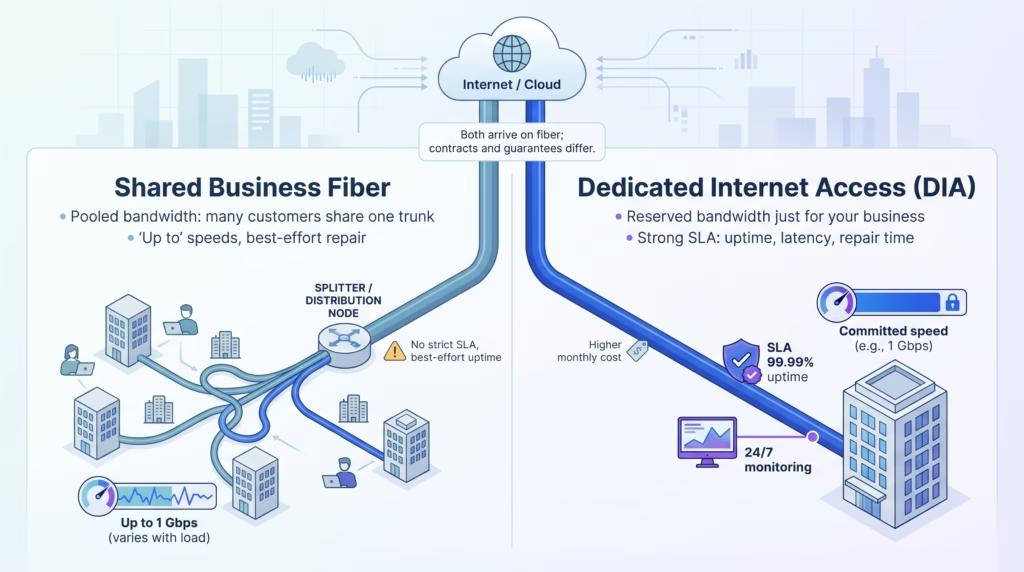
Shared business fiber pools dozens of customers on one trunk. Speeds are “up to” because everyone taps the same lane: you might see a full gigabit at 3 am, then 600 Mbps at 9 am when every VPN wakes up. Uploads equal downloads, far better than cable, yet the contract offers only best-effort repair; credits start after long outages and rarely match lost revenue.
Dedicated Internet Access (DIA) reserves a lane just for you. The circuit is provisioned at the exact speed you order, 100 Mbps to 10 Gbps, and the SLA nails down three numbers: uptime (often 99.99 percent, or about 4.4 minutes of downtime a month), maximum latency, and mean time to restore. Miss any target and the provider owes you credits. DIA links are monitored 24/7, so a fiber cut usually dispatches a truck before you finish dialing support.
That muscle costs real money, often four to six times the per-megabit price of shared fiber, and installs can stretch 45–90 days if new construction is needed. Yet for hospitals, SaaS stacks, and card-present retailers, the premium buys sleep.
Quick filter:
- If an hour-long outage mainly triggers coffee runs, order shared fiber, add a 5G modem, and pocket the savings.
- If downtime sends nurses home or stalls cloud revenue, budget for DIA and request the full SLA schedule up front.
Either way, ask where the hand-off lands, whether the route shares poles with your backup link, and how to claim credits. A five-minute call can save five digits the next time a bucket truck digs too deep.
Should you wait for LCUB fiber?
LCUB reported 37,676 locations passed as of April 1 2026 and projects full electric-territory completion in late 2027–early 2028. That sounds close, but in telecom time it spans two hardware refresh cycles and the average business lease.
Ask three questions:
- What is the hard cost of doing nothing?
Slow uploads and jittered video are an invisible tax. A 24-month, month-to-month TDS or Spectrum line at roughly $50–$90 a month often costs less than a single day of lost revenue during a big sale or patient-intake backlog. - How movable is your contract?
TDS, Spectrum, and Verizon 5G all offer month-to-month or 12-month terms. Sign one now, circle month 11, and jump to LCUB the minute your address turns green, with no ETF. - Will two diverse connections beat one cheap one?
Order LCUB as soon as it’s live, but keep a low-cost cable or 5G path for failover. The pair usually delivers higher uptime yet still undercuts dedicated fiber.
Bottom line: don’t freeze growth waiting on a splice crew. Grab a flexible circuit today, queue LCUB for tomorrow, and budget both links in your continuity plan so customers never see a loading spinner.
How to build a redundant internet setup
Downtime costs more than extra bandwidth. A single fiber cut, power surge, or congested cell tower can halt orders in seconds; redundancy turns that scare into a brief firewall alert.
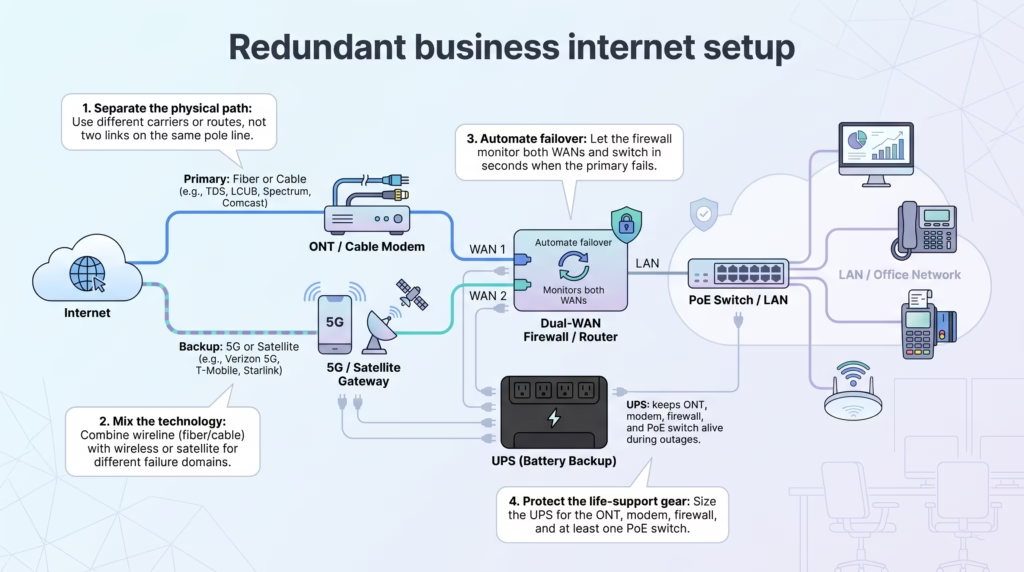
- Separate the physical path. Two circuits from the same carrier on the same pole line are twins. A true backup travels a different route: TDS fiber plus Spectrum coax, or LCUB fiber plus a Verizon 5G gateway. Ask every provider whether its drop shares poles, conduit, or upstream transport with your primary link.
- Mix the technology. Wireline plus wireless beats wireline plus wireline when every pole on Campbell Station Road feeds the same splice case. A self-install Verizon 5G Business ($65 a month) or T-Mobile Business Internet ($50 stand-alone, $35 with voice) adds a second failure domain and works on battery power.
- Automate failover. Firewalls from Fortinet, Cisco, and Ubiquiti can monitor two WANs and switch in seconds. Set thresholds for packet loss and latency, and run a quarterly test; nothing reveals a bad static route faster than unplugging the primary ONT at 9 am on a quiet Friday.
- Protect the life-support gear. Size your UPS for the ONT or cable modem, wireless gateway, firewall, and at least one PoE switch. Five minutes of battery lets a generator start or a cloud-failover plan engage.
Follow those four steps, and most outages shrink from headline risk to a minor line item.
Business internet contract and installation checklist
The glossy promo never shows the line items that drain budgets. Bring this list to every provider meeting, and you’ll leave with a clean, all-in quote.
Technology and hand-off: Confirm whether the circuit ends on Ethernet, SFP, or a cable modem, and note where the demarc lands; a five-foot move later can cost more than month one.
Speed (both directions): Ads flaunt download; insist on the committed upload figure in writing.
Static IP and IPv6: Ask if a static block is included, and whether IPv6 is native or tunneled, because your VPN appliance cares.
Service-level agreement: Request the SLA attachment—uptime percentage, maximum latency, mean time to restore, and credit formula. “Network reliability” marketing copy is not an SLA.
Install date and lead time: Shared circuits should install inside 10 business days; dedicated fiber often takes 45–90 days. Lock dates into the order form, and add penalties for slips.
Contract term and auto-renewal: Twelve months stays flexible; three years is common. Auto-renew clauses can trigger 60–90 days before term-end, so set a calendar alert now.
Early-termination fee: Is it prorated or the full remaining balance? Can you relocate service without penalty within the metro?
Promotion expiration: Circle the month the discount ends, note the day-one renewal rate, and negotiate a cap today.
Equipment and inside wiring: Modem rental, Wi-Fi extenders, and LTE failover hardware add recurring dollars. Demarc extensions cost extra if the IT room sits far from the drop.
Construction contribution: DIA and some new fiber installs may require sharing trench or conduit costs; get the figure before permits.
Power backup: Spec a UPS that supports the ONT, modem, firewall, and at least one PoE switch for 10 minutes or more.
Farragut fiber rollout timeline: past milestones and what comes next
Knowing where each provider sits on the construction curve helps you decide whether to order now or wait.
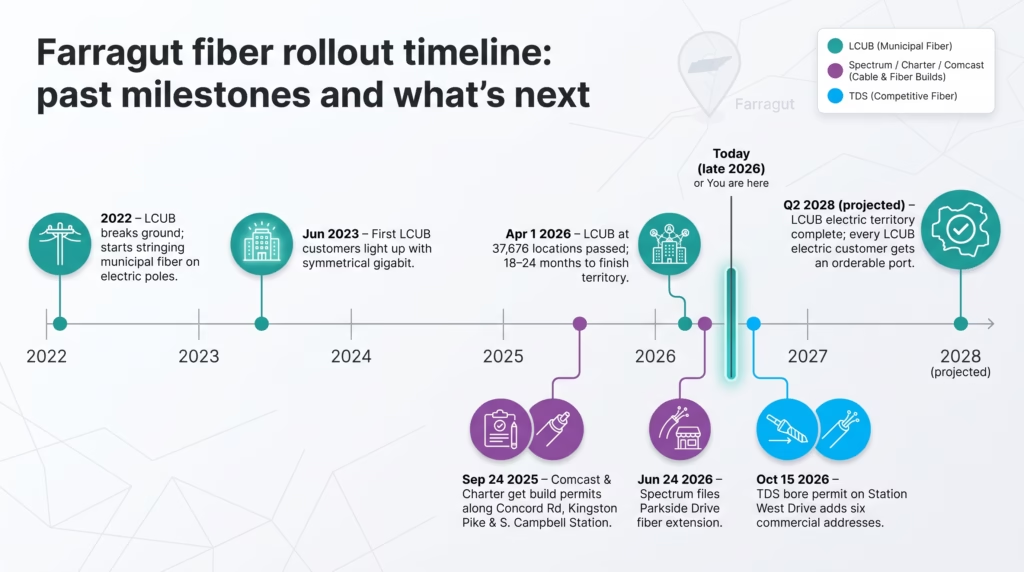
- 2022: LCUB breaks ground, starting to string municipal fiber on its electric poles.
- June 2023: First LCUB customers light up; early adopters in Farragut’s core report symmetrical gigabit service.
- April 1 2026: LCUB reports 37,676 locations passed and projects another 18–24 months to finish its electric territory (late 2027–early 2028).
- Q2 2028 (projected): LCUB electric-territory completion. If weather and supply chains cooperate, every LCUB electric customer should have an orderable port; addresses outside that grid will still rely on TDS, Spectrum, Comcast, or custom builds.
Takeaway: Multiple carriers already cover most Farragut addresses, and new fiber keeps rolling toward the last dark pockets. Lock month-to-month contracts now, and keep a backup path so you don’t feel trapped by yesterday’s option.
Frequently asked questions
Is LCUB fiber live at every Farragut address?
Not yet. LCUB reported 37,676 passings as of April 1 2026 and projects territory-wide completion in late 2027 – early 2028. Check your exact meter number before you cancel an existing line.
Does TDS really offer symmetrical gigabit everywhere?
Coverage is broad, about 99.8 percent of business addresses, but a few business-park buildings still ride legacy copper. Run the address checker; if you only see 300 Mbps, you’re on an older drop.
Is AT&T Business Fiber the same product as AT&T Dedicated Internet?
No. Business Fiber is a shared service with no SLA. Dedicated Internet reserves bandwidth just for you and carries a contract with defined credits for uptime, latency, and packet delivery.
What does 1 Gbps business internet cost in Farragut?
Current standalone prices run $89.99 on TDS fiber, $115 on Spectrum coax, $149 on Comcast coax, and $149.95 on LCUB fiber. Always ask for the post-promo rate and any equipment fees.
Does Spectrum Business include an uptime guarantee?
Standard coax plans are best-effort only. Spectrum Enterprise Fiber Internet carries a 99.9 percent SLA; Dedicated Fiber Internet lists 100 percent, but both are separate products and price sheets.
Which providers sell static IPs?
TDS, LCUB, Spectrum, Comcast, WOW!, Verizon 5G, T-Mobile (with upgrade), Starlink, and AT&T all offer them. Expect roughly $5–$20 a month on shared plans; blocks are included with DIA.
Is 5G business internet reliable enough for a primary line?
If an hour-long outage is just an inconvenience, yes. For revenue-critical workloads, treat 5G as backup; speeds and latency swing with tower load, building materials, and weather.
Can Starlink back up point-of-sale systems?
Yes, provided the dish has a clear sky view and your firewall fails over automatically. Keep the router on a UPS so brief power blips don’t drop the link.
How long does business-fiber installation take?
Shared fiber from TDS or LCUB usually installs in 7–15 business days when the building is already cabled. Dedicated builds from AT&T or Spectrum Enterprise typically take 45–90 days if conduit or permits are required.
Should I sign a multi-year contract?
Only if you trade term for real savings, such as a lower MRC, waived install, or a written renewal cap. Otherwise, stick with 12-month or month-to-month terms so you can pivot when new fiber reaches your street.
Conclusion
Farragut businesses already enjoy near-universal access to gig-class bandwidth, and competition is driving prices down while service levels climb. Today, TDS and Spectrum offer quick installs at aggressive promo rates, LCUB continues to extend transparent municipal fiber, and AT&T, Comcast, WOW!, and regional carriers fill specialist niches. Pair any primary line with a wireless or satellite backup to guard revenue, review every contract clause before signing, and mark calendar reminders for promo expirations. With construction crews still stringing new glass, your best strategy is flexibility: sign short terms now, track roll-outs, and re-quote annually so your connectivity keeps pace with your growth.