
For most global brands, the AI translation decision felt straightforward when they made it. Pick a model, connect it to the content workflow, and let it run. The speed gains were immediate. The cost savings were measurable. The output looked good enough to ship.
Two or three years into that decision, a different picture is emerging. Terminology that was consistent in one market drifts in another. Campaign copy that lands well in English comes back tonally flat in Polish or formally stiff in Brazilian Portuguese. Support content that read clearly at launch starts accumulating subtle inconsistencies across updates. The AI did not fail. It just did not perform the same way every time, and at global scale, that variance adds up.
The brands noticing this are not abandoning AI translation. They are asking a harder question: what does it mean to trust a single-model with content that represents your brand in ten languages simultaneously?
What Single-Model Adoption Actually Looks Like at Scale
The appeal of single-model translation is structural, not just convenient. Global content teams are already managing the AI tools already embedded in global brand workflows across content creation, campaign management, SEO, and analytics. Adding another layer of complexity to the localization step has real operational costs. One model, one API, one vendor relationship, predictable per-word pricing.
The business case for getting this right is not abstract. 96% of B2B leaders report positive ROI from localization efforts, and for global brands that figure is intuitive: customers buy more when they can read about a product in their own language, trust the brand more when the communication feels native, and churn less when support content is clear. The investment in localization is justified. The question is whether the AI layer is protecting that investment or quietly eroding it.
At low volume, the erosion is invisible. A single campaign in two languages, reviewed by someone with working knowledge of both, catches most of what slips through. At the scale a global brand actually operates, with dozens of markets, continuous content refreshes, and product updates shipping across languages simultaneously, the review bandwidth required to catch single-model errors simply does not exist.
The Disagreement Problem No One Talks About
The core issue with single-model AI translation is not that the models are bad. The top-tier models, GPT-4o, Claude, Gemini, DeepL, and others, produce genuinely good translation output across major language pairs. The issue is that they disagree with each other, and that disagreement reveals something important about how they work.
Ask three of those models to translate the same marketing headline and you will get three meaningfully different outputs. Not wrong in an obvious way. Different in tone, in vocabulary choice, in how they handle the implied audience, in whether they preserve the original register or shift it. Each model is drawing on different training data, different architectural decisions, and a different probabilistic distribution for how to render any given phrase. The outputs reflect those differences.
The problem is not the disagreement itself. The problem is that when a single-model produces one of those outputs, there is nothing in the workflow to tell you which version of the translation you got. You got the output of that model on that day, shaped by that model’s particular strengths and blind spots. Whether it was the best available rendering, or a plausible but slightly off-key one, is invisible until a native speaker in the target market notices something is wrong.
Where Errors Actually Come From
Part of what makes this hard to act on is that single-model error rates are not dramatic. Industry data synthesized from Intento’s research on translation AI performance and WMT24 benchmarking shows that individual top-tier AI models introduce errors or hallucinations in translation tasks at rates between 10% and 18%. In highly regulated sectors, that figure triggers compliance reviews. In marketing localization, the same error rate rarely triggers anything because the errors are not catastrophic. They are subtle.
A product description that sounds slightly more formal than your brand voice. A CTA that does not carry the urgency of the original. A regional idiom that got rendered literally. A tone that tests fine in one market but reads as condescending in another. These are not translation failures in a technical sense. They are quality gaps that accumulate across a content library and erode the consistency a global brand needs to maintain.
This is the moment where how global brands are stress-testing their AI decisions starts to shift. The early adopter instinct was to ask: does this model produce good output? The more experienced question is: does this model produce reliable output, across language pairs, content types, and update cycles, at a quality level I can stake brand representation on?
What Rethinking Looks Like in Practice
The brands moving past single-model adoption are not replacing AI with human translation. They are restructuring where verification happens in the workflow. Instead of relying on downstream human review to catch what the model got wrong, they are building verification into the AI step itself.
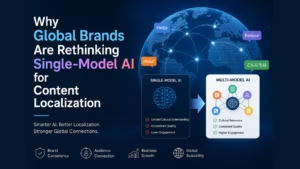
The approach gaining traction is consensus-based AI translation: running the source content through multiple models simultaneously, comparing the outputs, and delivering the rendering that the majority agree on. Instead of asking which model to trust, the workflow asks which output earned the most agreement. Models like ChatGPT, Claude, Gemini, DeepL, DeepSeek, Grok, Llama, and Mistral frequently disagree on the same sentence. When they do agree, that convergence is a stronger signal of accuracy than any single model’s confidence score.
The performance data behind this approach comes from an instructive source: MachineTranslation.com, an AI translation platform developed by Tomedes, a translation company with over fifteen years of production localization experience. Because Tomedes processes real-world content across every language pair and domain at scale, its benchmarks reflect actual production conditions rather than curated test sets. Running content through 22 models and selecting the consensus output reduces critical translation errors to under 2%, against the 10-18% error range seen with individual top-tier models. The error-catching step happens at the AI layer, before anything reaches human review.
The Operational Case for Consensus
For global brands, the operational argument for this approach is about terminology consistency as much as error reduction. Single-model output is stochastic, meaning the same source text can produce different outputs across sessions. At high volume, that variance means the same brand term, product name, or legal phrase gets rendered differently across documents, markets, and update cycles. The content library loses coherence over time in ways that are difficult to audit and expensive to repair.
Consensus-based approaches address this structurally. When the majority of 22 models agree on a rendering, the output reflects a more stable interpretation of the source content than any individual model would produce. Internal benchmarks from this architecture show terminology consistency rates above 96% across multi-document workflows, compared to approximately 78% for single-model outputs at equivalent volume. For brands operating across many languages simultaneously, the gap between those figures is the difference between a coherent content library and one that requires ongoing manual intervention to maintain.
Human verification remains available as a final layer for content where accuracy is non-negotiable, such as legal filings, medical communications, or financial disclosures. The practical shift is that consensus-based AI significantly narrows the scope of what requires that level of review, which reduces cost and turnaround time without reducing the quality ceiling.
A Different Question to Ask About Your AI Workflow
Global brands that have moved through the early adoption phase of AI translation are asking a question that was not on the table two years ago: not which AI model to trust, but how to build a workflow where no single model’s blind spots determine what reaches your audience.
That shift in framing changes what good localization infrastructure looks like. It is not about finding the model that performs best on average. It is about removing the single point of failure that comes with trusting any one model across the full range of languages, content types, and brand contexts that a global operation requires.
The brands rethinking single-model AI are not doing so because the models failed in a visible way. They are doing so because they have operated at enough scale to see what invisible, cumulative quality gaps cost when they go unchecked. The rethinking is not a retreat from AI. It is a more sophisticated use of it.