
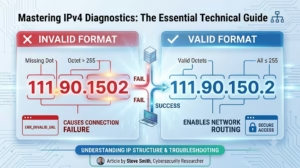
If you typed 111.90.1502 into your web browser’s address bar and received a connection failure—such as ERR_NAME_NOT_RESOLVED, ERR_INVALID_URL, or “This site can’t be reached”—the issue is structural rather than a network outage.
The address string 111.90.1502 is mathematically invalid under standard Internet Protocol Version 4 (IPv4) rules. As a result, your web browser cannot route your request to a target server or login portal.
Understanding why this string fails, identifying common typing errors, and understanding fundamental IP addressing and network troubleshooting will allow you to re-establish a functional connection to your intended network gateway or media server.
Why 111.90.1502 Fails: The IPv4 Octet Rule
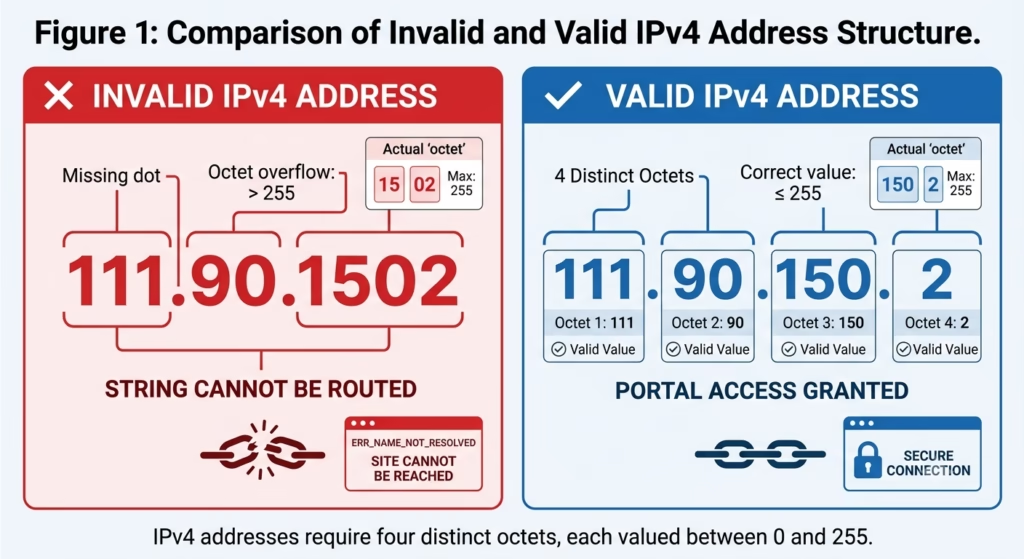
Every device, server, and gateway connected to the internet using IPv4 relies on a standardized address format known as dot-decimal notation. Under guidelines managed by the Internet Assigned Numbers Authority (IANA), an IPv4 address must follow specific mathematical constraints:
Four Octets: An address consists of four numerical segments (octets) separated by single periods.
8-Bit Boundaries: Each octet represents an 8-bit binary number ($2^8 = 256$ total values).
Value Range (0–255): Every individual segment must be an integer between 0 and 255. For a detailed technical breakdown of why numbers above 255 break IPv4 formatting, examine how 8-bit binary structures restrict numerical values.
When analyzing 111.90.1502:
First octet:
111(Valid: within 0–255)Second octet:
90(Valid: within 0–255)Third octet:
1502(Invalid: contains three missing periods or exceeds 255)
Because 1502 exceeds the maximum allowable value of 255, network stacks reject the input. In practical network testing across modern web browsers (Google Chrome, Microsoft Edge, Mozilla Firefox, and Apple Safari), entering an octet above 255 causes the browser to attempt a domain name lookup or fallback search query rather than sending an HTTP/HTTPS network request.
       [111]  .  [90]  .  [1502]
         |         |         |
      Valid     Valid    INVALID
  (0-255 range) (0-255)  (Exceeds 255 / Missing Dot)
Common Typographical Errors Breaking IP Routing
When users attempt to reach specific private administration portals, remote remote-access gateways, or proxy servers, rapid typing often leads to missed dots, extra digits, or transposed characters.
Below are the most common invalid strings related to this sequence and the structural errors causing them to fail:
1. Missing Dots (Combined Octets)
Invalid String:
111.90.1502Structural Error: The last two octets have merged due to a omitted period. If the target string was meant to be
111.90.150.2, the missing dot turns a standard four-octet address into an invalid three-octet address with an out-of-range value (1502).
2. Trailing Periods
Invalid String:
111.90.1502.Structural Error: Placing a trailing dot at the end of an already malformed address causes syntax errors in web browser URL parsers, leading directly to an
ERR_INVALID_URLresponse.
3. Octet Overflow (Values Over 255)
Invalid Strings:
111.90.150.284and111.90.150.288Structural Error: In these examples, the address properly contains four octets, but the final segment (
284or288) exceeds the maximum 8-bit threshold of 255. If you encounter similar issues on other servers, review our guide on handling invalid IP address structures.
4. Transposed Digits
Invalid String:
111.190150.204Structural Error: Merging the second and third octets creates a six-digit middle segment (
190150) that fails both length and value validation.
(If you specificially encountered an out-of-bounds octet error on a four-segment sequence, see our specialized 111.90.150.284 IP configuration guide.)
Syntax Diagnostics Matrix
| Typographical Input | Primary Failure Reason | Browser Error Code | Corrected Format Example |
111.90.1502 | Missing period; Octet overflow (1502 > 255) | ERR_NAME_NOT_RESOLVED | 111.90.150.2 |
111.90.1502. | Syntax parsing error; Trailing dot | ERR_INVALID_URL | 111.90.150.2 |
111.190150.204 | Merged middle octets (190150) | ERR_NAME_NOT_RESOLVED | 111.190.150.204 |
111.90.150.284 | Final octet overflow (284 > 255) | Server Not Found | 111.90.150.24 / 111.90.150.84 |
111.90.150.288 | Final octet overflow (288 > 255) | Server Not Found | 111.90.150.88 / 111.90.150.208 |
Step-by-Step Fixes to Access Your Target Gateway
If you are trying to open a legitimate administration portal, video server, or network management interface, follow these steps to isolate and fix the connection issue.
Step 1: Correct the IP Format
Examine the exact IP address provided by your network administrator, device documentation, or service panel. Ensure that:
There are exactly four numerical segments.
Each segment is separated by a single period (
.).No single segment exceeds 255.
There are no spaces, trailing dots, or letters added to the string.
Step 2: Explicitly Define the Protocol (HTTP vs. HTTPS)
When typing an IP address into a browser bar, modern browsers default to searching the web via HTTPS. If the target server uses an unencrypted administrative interface on standard HTTP (or uses a custom port), the browser may fail to load the page.
Try entering the full protocol explicitly:
For standard web interfaces:
[http://111.90.150.](http://111.90.150.)XFor secure web interfaces:
[https://111.90.150.](https://111.90.150.)XFor custom administrative ports:
[http://111.90.150.](http://111.90.150.)X:8080or[http://111.90.150.](http://111.90.150.)X:80
(Replace X with the valid final octet provided for your system).
Step 3: Flush Local DNS and Socket Pools
If you previously attempted to navigate to 111.90.1502, your browser or operating system may have cached a failed lookup attempt. Clearing these caches forces the browser to re-evaluate the corrected address.
In Google Chrome: Navigate to
chrome://net-internals/#dnsand click Clear host cache. Then navigate tochrome://net-internals/#socketsand click Flush socket pools.In Windows (Command Prompt): Open Command Prompt as Administrator and run:
DOSipconfig /flushdnsIn macOS (Terminal): Open Terminal and run:
Bashsudo dscacheutil -flushcache; sudo killall -HUP mDNSResponder
Step 4: Verify Network Reachability
Addresses starting with 111.X.X.X belong to public IP address blocks rather than local private address ranges (such as 192.168.X.X or 10.X.X.X).
If you are attempting to reach a remote server or media gateway:
Ensure your active internet connection is stable.
If the gateway requires restricted network access, confirm whether you need to connect through an authorized Virtual Private Network (VPN) or enterprise proxy first.
Open a terminal or command prompt and test basic routing using the
pingcommand with a corrected IP address:Bashping 111.90.150.2
Security Considerations When Accessing Unfamiliar IP Gateways
When troubleshooting IP addresses found online or provided in third-party media configuration guides, maintain standard cybersecurity precautions:
Verify the Target Identity: Never enter account credentials, passwords, or personal data into an IP-based login page unless you have verified who owns and operates the server.
Look out for Invalid SSL Certificates: Public IP addresses often lack trusted SSL/TLS certificates signed by recognized Certificate Authorities. If your browser displays a warning stating “Your connection is not private,” exercise caution before proceeding.
Avoid Unverified Proxies: Modifying your network configuration to route traffic through unfamiliar public IP addresses can expose your unencrypted data to interception or man-in-the-middle (MITM) attacks.
FAQ Section
Frequently Asked Questions
Why does my browser search Google when I enter 111.90.1502?
Web browsers recognize valid IPv4 formats. When an input breaks IP address rules—such as containing an octet above 255 like 1502—the browser assumes the input is a search query rather than a destination network URL and redirects it to your default search engine.
Is 111.90.1502 a private or public IP address?
111.90.1502 is an invalid string. However, valid IP addresses starting with 111. (such as 111.90.150.2) fall within the public IP address space assigned to regional internet registries, primarily servicing networks in the Asia-Pacific region.
What is the maximum number allowed in an IP address octet?
The maximum value for a standard IPv4 octet is 255. This is because each octet consists of 8 bits in binary (11111111 in binary equals 255 in decimal). Any value of 256 or higher is mathematically invalid for standard IPv4 addressing.
How do I know what the correct IP address should be?
Check your router label, network configuration documentation, or administrator instructions. If you were following a remote server guide, look closely for omitted periods or typos in the original instructions.
About the Author
Steve Smith is a cybersecurity researcher and technical writer specializing in network diagnostics, WHOIS intelligence, and threat telemetry. With a background in systems analysis, Steve translates complex IP routing data, server logs, and security infrastructure into actionable insights for webmasters and network administrators. When not analyzing network traffic, he focuses on making web security accessible to everyday internet users.